Understanding Stress‑Induced Muscle Tension
When the body perceives a threat, the sympathetic nervous system triggers the "fight‑or‑flight" response, flooding the bloodstream with cortisol and adrenaline. These hormones cause rapid, involuntary contraction of skeletal muscles, especially in the neck, shoulders, upper back and lower back, creating hyper‑tonic bands that feel like knots or trigger points. Prolonged exposure keeps the muscles in a semi‑contracted state, limiting circulation, raising local lactic acid, and reinforcing pain signals. At the same time, chronic stress suppresses serotonin and dopamine production, worsening mood and amplifying pain perception. Non‑invasive, drug‑free therapies—chiropractic adjustments to massage therapy—address both sides of the equation: adjustments restore proper spinal alignment and reduce nerve irritation, while massage releases tight fascia, improves blood flow, and lowers cortisol while boosting serotonin and dopamine. This synergistic, patient‑centered approach avoids medication side‑effects, supports the parasympathetic nervous system, and promotes lasting relief of stress‑related muscle tension.
Why Combine Chiropractic Adjustments with Massage Therapy?
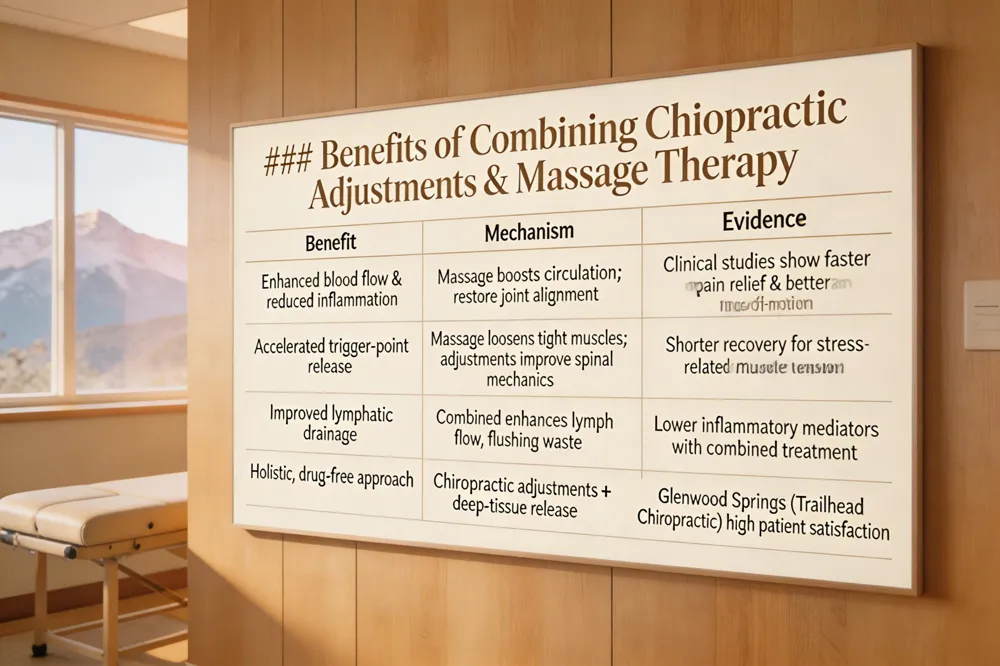
Benefits of Combining Chiropractic Adjustments & Massage Therapy
| Benefit | Mechanism | Evidence |
|---|---|---|
| Enhanced blood flow & reduced inflammation | Massage boosts local circulation; adjustments restore joint alignment, decreasing nerve irritation | Clinical studies show faster pain relief and greater range‑of‑motion gains when both are used together |
| Accelerated trigger‑point release | Massage loosens tight muscle fibers; adjustments improve spinal mechanics | Integrated care shortens recovery time for stress‑related muscle tension |
| Improved lymphatic drainage | Combined modality enhances lymph flow, flushing metabolic waste | Research indicates lower inflammatory mediators with combined treatment |
| Holistic, drug‑free approach | Neurologically based adjustments + deep‑tissue/mofascial release | Glenwood Springs clinics (e.g., Trailhead Chiropractic) report high patient satisfaction |
 Synergistic effects on blood flow and inflammation
Massage increases local circulation, delivering oxygen and nutrients while flushing metabolic waste. Chiropractic adjustments restore proper joint alignment, reducing nerve irritation that sustains muscle guarding. Together they enhance lymphatic drainage and lower inflammatory mediators, creating a faster healing environment.
Research shows faster pain relief and range‑of‑motion gains
Clinical studies demonstrate that patients receiving both spinal adjustments and targeted massage report quicker pain reduction and greater improvements in flexibility than those treated with either modality alone. Integrated care accelerates trigger‑point release, improves spinal mechanics, and shortens recovery time for stress‑related muscle tension.
Local clinic expertise in Glenwood Springs
Glenwood Springs clinics—such as Trailhead Chiropractic and Mountain Shadows Rehabilitation—offer neurologically based adjustments paired with deep‑tissue, myofascial release, and trigger‑point massage. Their high‑altitude, active‑outdoor patient base benefits from this drug‑free, holistic approach.
How to relieve upper back pain from stress
Check ergonomics, stretch daily (cat‑cow, doorway stretch), practice deep breathing, and schedule a chiropractic adjustment to realign the thoracic spine and release muscle knots.
Trailhead Chiropractic Glenwood Springs
Located at 51241 HWY 6, Suite 8B, the clinic provides neurologically based adjustments, therapeutic massage, and soft‑wave therapy. Dr. Tom’s team creates individualized plans for back pain, sciatica, and post‑injury recovery. Call (970) 456‑4562 to book.
Side effects of deep tissue massage
Temporary soreness, mild bruising, dizziness, or light‑headedness may occur. Rarely, excessive pressure can cause transient numbness. Effects resolve with rest, hydration, and gentle stretching.
How to relieve stress for a woman
Begin with mindful breathing, follow with gentle neck‑shoulder stretches, receive a chiropractic adjustment to lower cortisol, add daily yoga or meditation, and prioritize quality sleep. Regular combined care sustains hormonal balance and overall well‑being.
Practical Self‑Care Strategies for Immediate Stress Relief
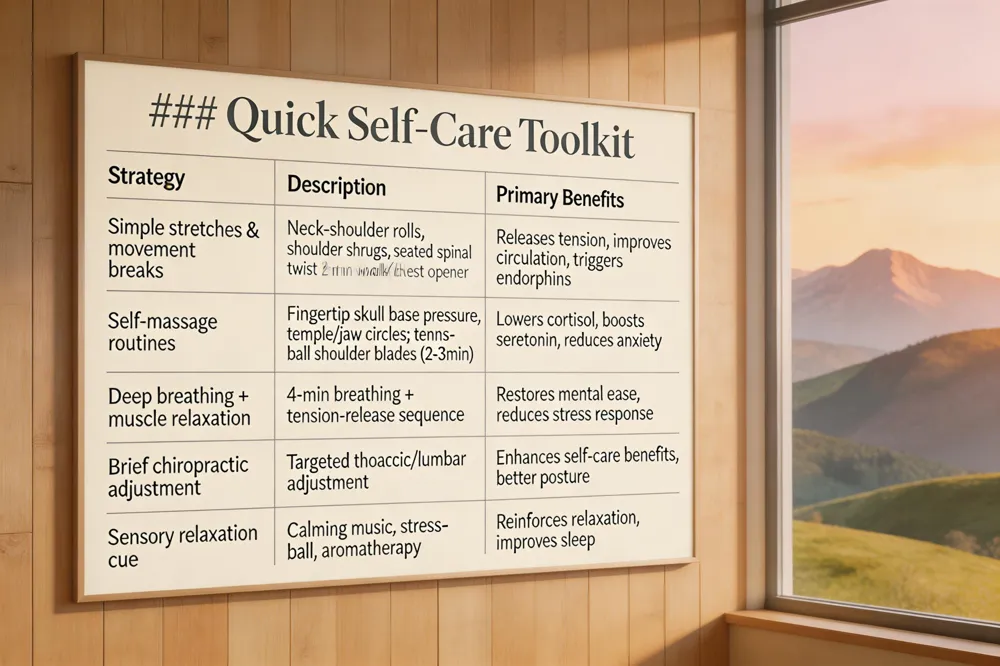
Quick Self‑Care Toolkit
| Strategy | Description | Primary Benefits |
|---|---|---|
| Simple stretches & movement breaks | Neck‑shoulder rolls, shoulder shrugs, seated spinal twist every hour; 2‑minute walk or doorway chest opener | Releases tension, improves circulation, triggers endorphin release |
| Self‑massage routines | Fingertip pressure at base of skull moving up trapezius; temple & jaw circles; tennis‑ball between shoulder blades (2‑3 min) | Lowers cortisol, boosts serotonin, reduces anxiety |
| Deep breathing + progressive muscle relaxation | 4‑minute breathing + muscle tension‑release sequence | Restores mental ease, reduces physiological stress response |
| Brief chiropractic adjustment (if available) | Targeted thoracic or lumbar adjustment to unload spinal tightness | Enhances benefits of other self‑care actions, promotes better posture |
| Sensory cue for lock‑in relaxation | Calming music, stress‑ball squeeze, aromatherapy | Reinforces relaxation state, improves sleep quality |
 Simple stretches and movement breaks – Perform gentle neck‑shoulder rolls, shoulder shrugs, and a seated spinal twist every hour. A brief 2‑minute walk or doorway chest opener releases muscle tension, improves circulation, and triggers endorphin release.
Self‑massage routines – Use fingertips to press the base of the skull and glide upward along the trapezius, then massage the temples and jawline in small circles. Apply a tennis ball between the shoulder blades for 2‑3 minutes to dissolve trigger points. This lowers cortisol, boosts serotonin, and reduces anxiety.
Quick anxiety‑reduction tips – Combine deep breathing with a four‑minute progressive muscle relaxation, followed by a short, targeted chiropractic adjustment (if available) to unload spinal tightness. Finish with a sensory cue—listening to calming music or squeezing a stress ball—to lock in relaxation.
Key take‑aways – Self‑massage calms the nervous system, deep breathing restores mental ease, movement breaks prevent stiffness, and brief chiropractic care amplifies all benefits, offering a drug‑free, evidence‑based toolkit for immediate stress relief.
Targeted Massage Techniques for Specific Tension Zones
Massage Techniques & Their Targets
| Technique | Target Zones | Primary Benefits |
|---|---|---|
| Swedish massage | Whole body, especially upper back & neck | Lowers cortisol, boosts serotonin, promotes relaxation |
| Deep‑tissue massage | Trapezius, levator scapulae, suboccipital, lumbar paraspinals | Breaks down adhesions, improves range of motion, reduces chronic knots |
| Trigger‑point therapy | Hyper‑irritable spots within the above muscles | Directly releases knot pain, restores muscle function |
| Myofascial release | Fascia surrounding trapezius, levator scapulae, suboccipital, lumbar area | Restores elasticity, relieves referred pain |
| Aromatherapy / Hot‑stone adjunct | Whole body (optional) | Further calms parasympathetic nervous system, deepens relaxation |
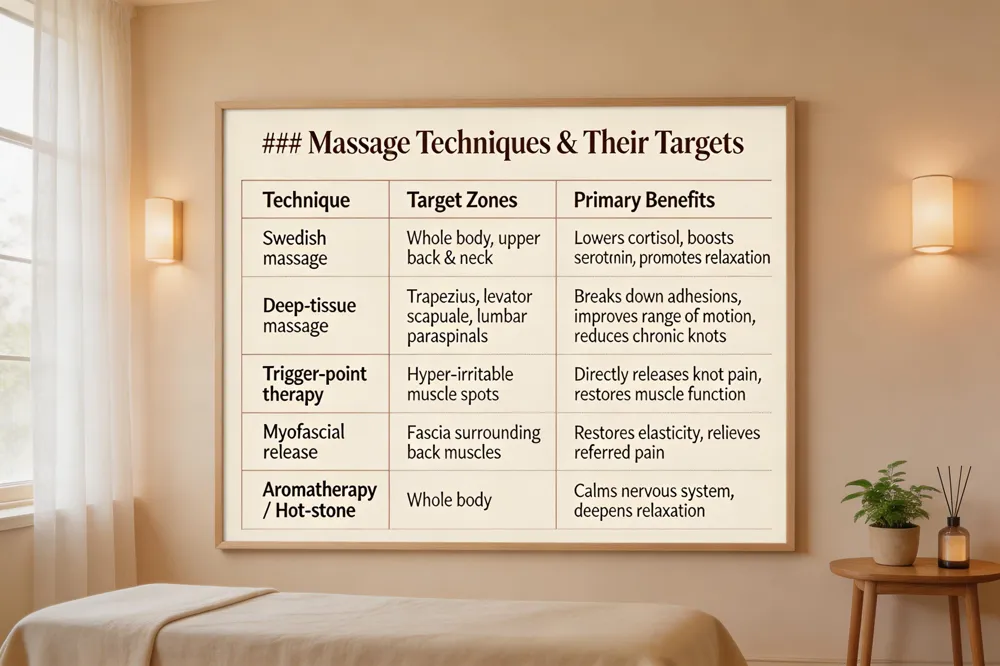 In Glenwood Springs, our chiropractic clinic blends evidence‑based massage modalities to address the most common stress‑related tension zones. Swedish massage offers long, flowing strokes that lower cortisol and boost serotonin, making it an excellent first‑line tool for anxiety relief. deep‑tissue massage adds slow, sustained kneading to break down adhesions in the trapezius, levator scapulae, suboccipital, and lumbar paraspinal muscles, improving range of motion and reducing chronic knots. Trigger‑point therapy zeroes in on hyper‑irritable spots within these same muscle groups, while myofascial release targets the surrounding fascia to restore elasticity and relieve referred pain. For added relaxation, we incorporate aromatherapy or hot‑stone techniques, which further calm the parasympathetic nervous system.
Swedish massage for anxiety – The gentle, rhythmic strokes shift the nervous system from fight‑or‑flight to rest‑and‑digest, lowering cortisol and promoting a clear, balanced mind.
Stress‑relieving massage points – Key hot spots include the upper trapezius, levator scapulae, suboccipital, and lumbar paraspinals; light circular pressure on acupressure points such as Yintang, LI4, and GB20 enhances calm.
Best massage for stress and tension – A Swedish‑style full‑body massage, possibly combined with aromatherapy, provides the most balanced approach for immediate stress relief, while deep‑tissue work addresses deeper chronic tightness.
Best massage for anxiety and depression – Therapeutic Swedish massage paired with myofascial release and Trigger‑point therapy lowers cortisol, raises serotonin and dopamine, and supports mood stability and better sleep.
Overall recommendation – Integrating Swedish, deep‑tissue, trigger‑point, and myofascial release—augmented by aromatherapy or hot‑stone options—targets the trapezius, levator scapulae, suboccipital, and lumbar paraspinals for comprehensive stress‑induced muscle tension relief.
Choosing the Right Local Provider in Glenwood Springs
Choosing a Provider – Quick Comparison
| Provider | Services Offered | Key Considerations |
|---|---|---|
| Trailhead Chiropractic (HWY 6, Suite 8B) | Neurologically based adjustments, therapeutic massage, soft‑wave therapy | Convenient location, flexible scheduling, drug‑free holistic care |
| Backcountry Chiropractic (Dr. Blake McDonald) | Evidence‑based adjustments, personalized exercise, therapeutic massage | Family‑owned, on‑site parking, insurance verification |
| Glenwood Chiropractic Center | Precise adjustments, therapeutic massage, laser therapy, X‑ray | High patient satisfaction, focus on posture & core strength |
| Acupuncture Glenwood Springs | Hour‑long acupuncture sessions ($45‑$95) integrated with chiropractic care | Targets inflammation & stress via parasympathetic activation |
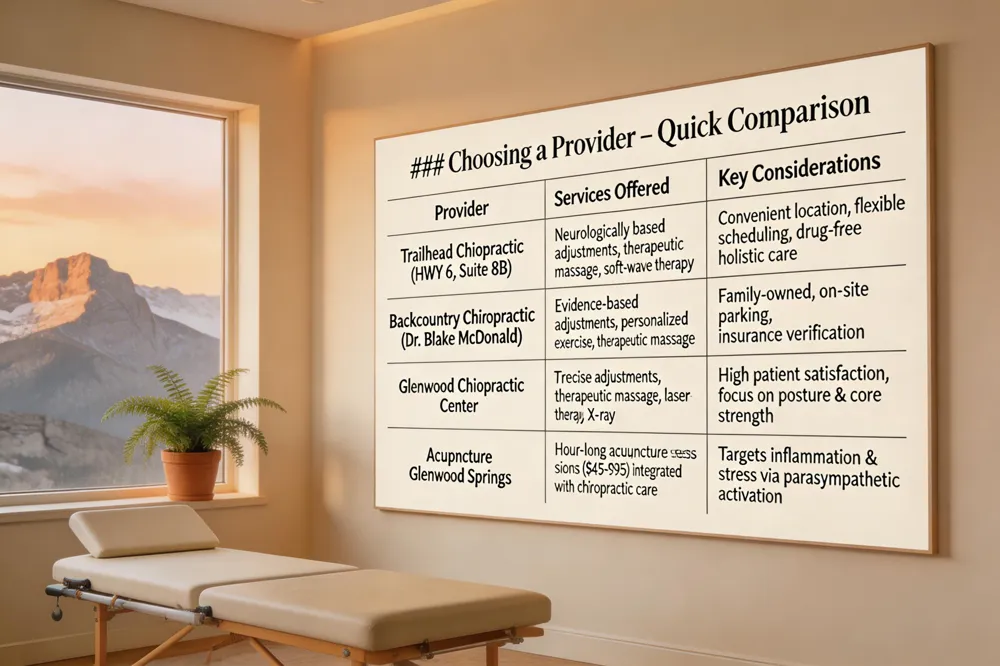 Choosing a provider who blends chiropractic and massage care can dramatically improve relief from stress‑induced muscle tension. Below are key considerations for Glenwood Springs residents.
Backcountry Chiropractic Glenwood Springs Backcountry Chiropractic, led by Dr. Blake McDonald, offers evidence‑based spinal adjustments, therapeutic massage, and personalized exercise programs. The family‑owned practice provides flexible scheduling, on‑site parking, and insurance verification, making it a convenient, non‑invasive option for back, neck, and sports‑related strains.
Glenwood Chiropractic Center reviews Patients consistently commend the clinic’s knowledgeable staff, gentle yet effective adjustments, and individualized care plans. High satisfaction scores reflect rapid pain relief, restored mobility, and a compassionate environment.
Acupuncture Glenwood Springs Acupuncture sessions (hour‑long, $45‑$95) target pain, digestive issues, and stress by activating the parasympathetic system. Integrated with chiropractic adjustments, acupuncture reduces inflammation and enhances overall mobility.
Chiropractor near me Search “chiropractor near me” to locate Trailhead Chiropractic (HWY 6) and other highly rated providers within a half‑mile of downtown. Choose a clinic that aligns with your schedule, health goals, and offers a comprehensive, drug‑free treatment plan.
Is there such a thing as a chiropractic massage? Yes. Chiropractic massage combines spinal adjustments with soft‑tissue techniques (trigger‑point, myofascial release, cupping) to relax muscles, improve circulation, and accelerate recovery.
Do chiropractors recommend massages? Most chiropractors advise massage as part of a holistic plan—often before an adjustment to loosen tissue and after to maintain joint stability and reduce soreness.
Glenwood Chiropractic Center The center provides precise adjustments, therapeutic massage, laser therapy, and on‑site X‑ray, focusing on posture, core strength, and lifestyle education for lasting pain relief.
Putting It All Together for Long‑Term Wellness
Integrating chiropractic adjustments with targeted massage therapy creates a synergistic effect: adjustments restore spinal alignment while massage releases trigger‑point knots, improves circulation, and lowers cortisol, leading to faster pain relief, greater range of motion, and reduced reliance on medication. To sustain these gains, patients should adopt supportive lifestyle habits—regular gentle stretching or myofascial release, ergonomic workstations, adequate hydration, balanced nutrition, and daily deep‑breathing or mindfulness exercises. Outdoor activities common to Glenwood Springs—hiking, skiing, and cycling—are best enjoyed when balanced with post‑activity foam‑rolling and sleep‑quality monitoring. Residents are encouraged to schedule a comprehensive assessment at a local clinic, such as Mountain Shadows Chiropractic or Trailhead Chiropractic, where a personalized plan can combine spinal adjustments, neuromuscular or deep‑tissue massage, and education on home self‑care. Consistent weekly or bi‑weekly visits, paired with the outlined habits, empower Glenwood Springs locals to break the stress‑tension cycle and achieve lasting musculoskeletal wellness.