Why Non‑Surgical Options Matter
Degenerative disc disease affects a large portion of the adult population—studies show about 30% of people under 65 have visible disc changes, rising to nearly 100% by age 80. Because most patients achieve relief without surgery, guidelines recommend a first‑line, conservative approach: education, weight management, core‑strengthening physical therapy, ergonomic adjustments, and judicious use of NSAIDs or short‑course muscle relaxants. The primary goals of non‑invasive care are to reduce pain and inflammation, restore functional mobility, improve spinal stability, and slow further disc degeneration, thereby preserving quality of life while avoiding the risks of operative intervention and supporting spinal health through plans.
Understanding Degenerative Disc Disease and Its Stages
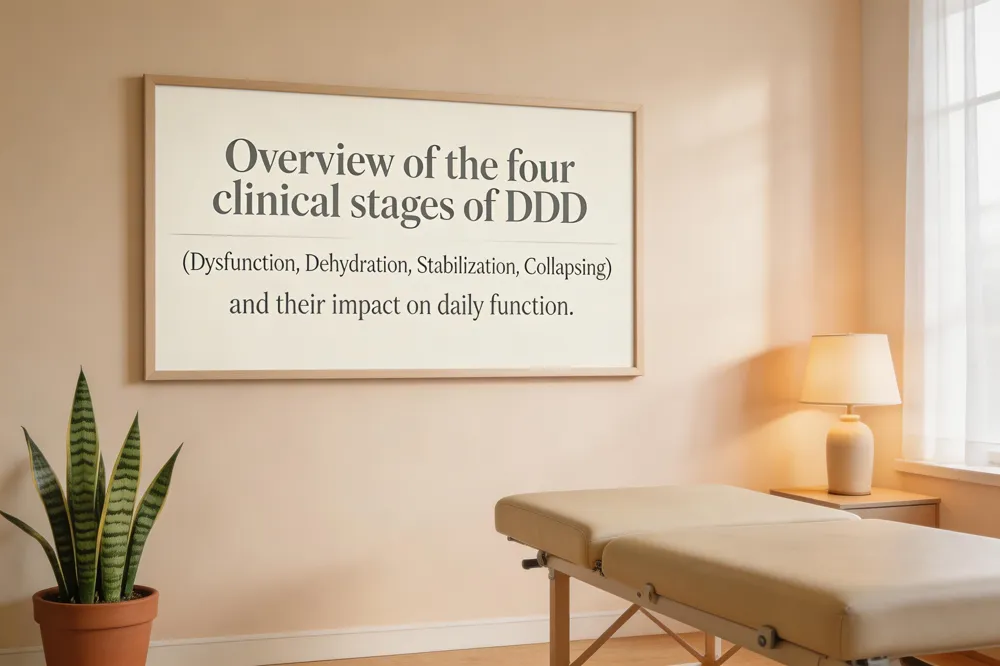 Degenerative disc disease (DDD) begins when the nucleus pulposus loses water and the annulus fibrosus weakens, reducing shock‑absorption and altering load distribution across the spine. Over time, biochemical depletion, micro‑tears, and inflammatory mediators accelerate disc collapse and spur formation.
Four clinical stages
- Dysfunction Stage: early structural changes, mild curvature alteration, typically painless.
- Dehydration Stage: disc desiccation and thinning, occasional bulging, mild‑to‑moderate discomfort that worsens with prolonged sitting.
- Stabilization Stage: notable height loss, osteophyte growth, nerve irritation, persistent pain with occasional radicular symptoms.
- Collapsing (Severe) Stage: advanced height loss, extensive bone spurs, chronic pain, stiffness, and functional limitation.
Impact on daily life
Patients may experience limited mobility, difficulty bending, lifting, or sitting for extended periods, and may develop compensatory postures that strain surrounding musculature.
What are the four stages of degenerative disc disease?
The first stage, called the Dysfunction Stage, involves early structural changes in the disc and a slight alteration of spinal curvature, usually without any noticeable pain. In the Dehydration Stage, the disc loses water, becomes thinner, and may begin to bulge, producing mild to moderate back discomfort that worsens with prolonged sitting or activity. The Stabilization Stage is marked by significant disc‑height loss, formation of osteophytes (bone spurs), and increased pressure on nearby nerves, leading to more persistent pain and occasional radiating symptoms. Finally, the Collapsing (or Severe Degeneration) Stage features advanced loss of disc height, extensive bone spur growth, and possible nerve compression, resulting in chronic pain, stiffness, and functional limitation.
Can I live with degenerative disc disease without surgery?
Yes—you can often manage degenerative disc disease without undergoing surgery. A combination of non‑invasive therapies such as chiropractic adjustments and targeted physical‑therapy exercises, and corrective posture work can relieve pain and improve mobility. Over‑the‑counter NSAIDs, prescription anti‑inflammatories, muscle relaxants, or short‑term corticosteroids are frequently used to reduce inflammation and muscle spasms. Maintaining a healthy weight and staying active further lessen stress on the spine and help prevent symptom progression. Most patients achieve long‑term pain control and functional improvement through these conservative measures, reserving surgery only for cases that do not respond to such treatment.
Chiropractic Care: What It Does and Safety Considerations
 Degenerative disc disease (DDD) is managed through a thorough clinical evaluation that may include imaging (X‑ray, MRI) to confirm spinal stability and rule out severe herniation. Once cleared, chiropractors employ gentle, low‑force techniques—such as flexion‑distraction, instrument‑assisted manipulation, or light thrusts—to restore joint mechanics and relieve nerve irritation without stressing the disc. Soft‑tissue therapies (massage, trigger‑point release, Graston technique) relax surrounding musculature, improve circulation, and reduce inflammatory mediators. Adjunct modalities like spinal decompression, low‑level laser, and TENS further decompress disc space and modulate pain signals. A personalized home‑exercise program emphasizing core stabilization, posture, and low‑impact aerobic activity supports disc hydration and long‑term function. When performed by a qualified practitioner who tailors treatment to the patient’s imaging and symptom profile, chiropractic care is generally safe for early‑stage DDD and does not worsen degeneration; aggressive thrusts are avoided in cases of severe instability or nerve compromise.
Managing Specific Disc Issues Non‑Surgically
 How can I manage a herniated disc at L4‑L5 without surgery?
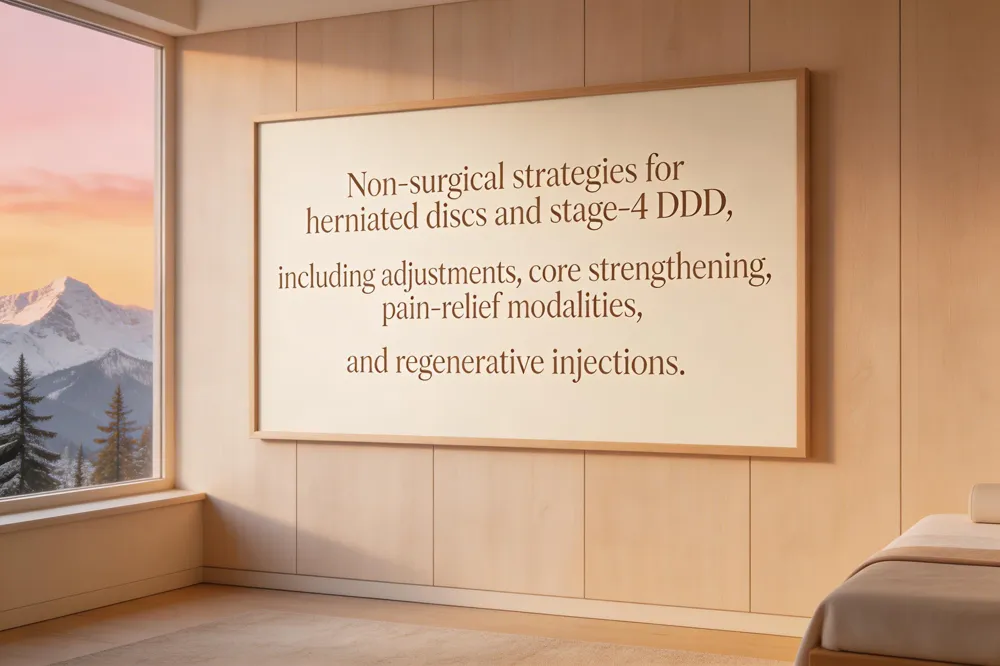
Gentle, targeted spinal adjustments and mobilizations performed by a chiropractor improve alignment, reduce nerve compression, and enhance blood flow. Complementary modalities such as ice, heat, low‑level laser and TENS control inflammation and pain. A structured core‑strengthening and flexibility program stabilizes the lumbar region, while ergonomic education and weight‑management reduce mechanical load.
How can I manage a herniated disc at L4‑L5 without surgery?
Gentle, targeted spinal adjustments and mobilizations performed by a chiropractor improve alignment, reduce nerve compression, and enhance blood flow. Complementary modalities such as ice, heat, low‑level laser and TENS control inflammation and pain. A structured core‑strengthening and flexibility program stabilizes the lumbar region, while ergonomic education and weight‑management reduce mechanical load.
What is the best pain relief for degenerative disc disease? A multimodal regimen is most effective. Over‑the‑counter NSAIDs (ibuprofen, naproxen) lower inflammation; short‑term prescription anti‑inflammatories or muscle relaxants may be added. Chiropractic adjustments combined with therapeutic heat, electrical stimulation, or low‑level laser restore joint mechanics and relieve nerve irritation. Physical‑therapy emphasizes core stability, posture correction, and gentle stretching. Maintaining a healthy weight further decreases disc stress.
What treatments are recommended for stage 4 degenerative disc disease? A comprehensive non‑surgical plan includes spinal decompression, precise chiropractic adjustments, and regenerative injections such as PRP or stem‑cell biologics to promote repair. Integrated rehab—core strengthening, motor‑control exercises, and manual therapy—supports functional recovery. Lifestyle counseling on ergonomics, activity modification, and nutrition helps prevent further degeneration.
Emerging Regenerative and Minimally Invasive Therapies
 What new treatments are emerging for degenerative disc disease?
Regenerative injection therapies are reshaping DDD care. Platelet‑rich plasma (PRP) delivers concentrated growth factors that stimulate extracellular‑matrix repair, while autologous stem‑cell and exosome injections aim to restore disc hydration and height. Ozone disc injection and methylene‑blue disc injection provide anti‑inflammatory relief and pressure reduction without altering anatomy. Orthobiologic products such as the VIA Disc—allograft, which injects disc‑derived growth factors and cytokines—seek to rebuild disc structure and improve biomechanics. These biologic approaches are often combined with minimally invasive modalities like percutaneous decompression, radio‑frequency ablation, and image‑guided epidural steroids to target pain sources while preserving spinal motion.
What is the best non‑surgical treatment for degenerative disc disease?
A multimodal, patient‑centered plan that integrates targeted physical therapy, core‑strengthening, posture education, and low‑impact aerobic activity is the cornerstone. Adding spinal adjustments or flexion‑distraction techniques enhances joint mechanics and reduces nerve irritation. When pain persists, adjuncts such as low‑level laser, TENS, or regenerative injections (PRP, stem‑cell, exosome) can accelerate healing. Lifestyle modifications—including weight loss, smoking cessation, and ergonomic adjustments—support long‑term disc health and minimize the need for surgery.
Practical Lifestyle Guidance and Finding Care in Glenwood Springs
 Activity modifications for degenerative disc disease focus on protecting the spine while staying active. Avoid heavy lifting, repetitive bending or twisting, high‑impact sports (running, basketball, contact athletics), and prolonged static positions such as long sitting or standing. Instead, choose low‑impact aerobic work—walking, swimming, cycling—and core‑strengthening routines that support the spine without overloading the discs. Weight management and ergonomics are equally vital: maintain a healthy body weight to reduce axial load, use ergonomic chairs and supportive mattresses, and practice neutral‑spine posture when sitting, lifting, or driving. Regular micro‑breaks for stretching improve disc nutrition and lessen pain spikes. Finding qualified chiropractor in Glenwood Springs, CO search for providers who list degenerative disc disease or spinal decompression among their services. Glenwood Chiropractic, a locally owned clinic, offers gentle adjustments, motorized decompression and personalized home‑exercise plans. Verify licensure, read patient reviews, and schedule a new‑patient consultation to discuss a multimodal, non‑surgical treatment strategy.
A Holistic Path Forward
Integrating evidence‑based non‑surgical options—such as targeted physical‑therapy, core‑stabilization exercises, low‑impact aerobic activity, ergonomic education, and complementary modalities like chiropractic adjustments, acupuncture, and regenerative injections (PRP or stem‑cell therapy)—creates a multimodal plan that addresses pain, inflammation, and mechanical stress. Early intervention leverages the body’s natural healing capacity, preserving disc hydration and height, which translates into long‑term functional gains and reduced need for surgery. A commitment to personalized care means each patient receives a tailored regimen, regular outcome monitoring, and education, ensuring therapies evolve with progress and empower individuals to maintain spinal health for life.