Understanding the TPI Golf Assessment and Its Relevance to Golfers
The Titleist Performance Institute (TPI) system is a globally recognized, evidence‑based framework that evaluates a golfer’s physical capabilities—mobility, stability, balance and coordination—rather than focusing solely on swing mechanics. By screening key movement patterns (e.g., thoracic rotation, hip‑to‑shoulder ratio, core stability) the TPI Golf Assessment uncovers the “pink elephant,” the single limitation that most limits performance. This information is vital because the body’s ability to move efficiently directly dictates swing speed, consistency, and injury risk. When TPI findings are combined with chiropractic care, the chiropractor can address joint restrictions, spinal subluxations, and soft‑tissue tension that underlie the identified deficits. Adjustments restore proper alignment and neural communication, while targeted corrective exercises and mobility work resolve the movement limitations highlighted by the assessment. The result is a holistic, patient‑centered plan that improves swing efficiency, reduces pain, and supports long‑term golf performance.
TPI Assessment Fundamentals and Test Battery
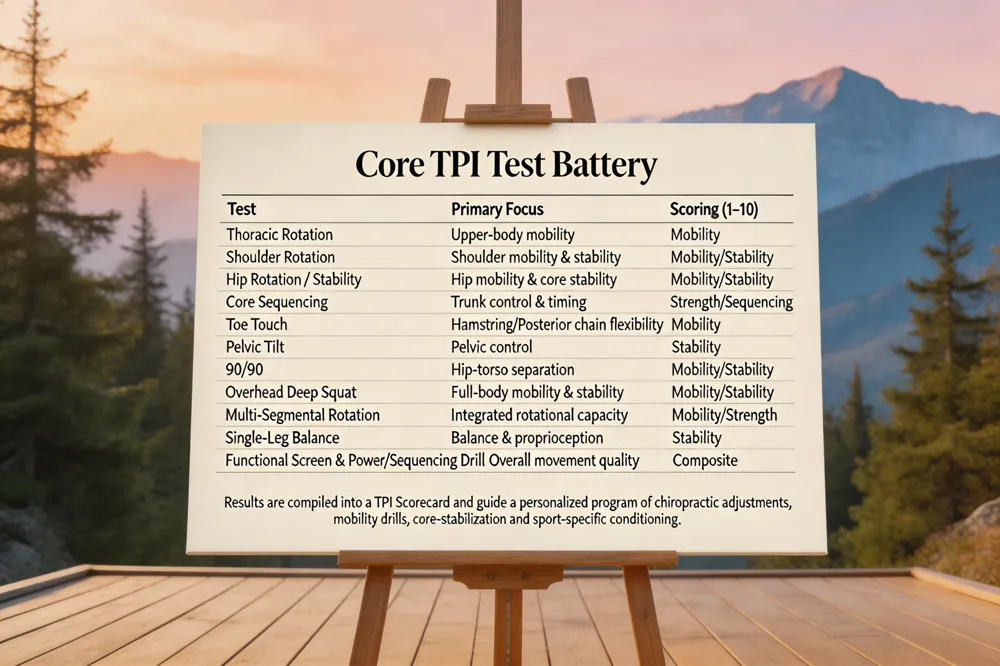
Core TPI Test Battery
| Test | Primary Focus | Scoring (1‑10) |
|---|---|---|
| Thoracic Rotation | Upper‑body mobility | Mobility |
| Shoulder Rotation | Shoulder mobility & stability | Mobility/Stability |
| Hip Rotation / Stability | Hip mobility & core stability | Mobility/Stability |
| Core Sequencing | Trunk control & timing | Strength/Sequencing |
| Toe Touch | Hamstring/Posterior chain flexibility | Mobility |
| Pelvic Tilt | Pelvic control | Stability |
| 90/90 | Hip‑torso separation | Mobility/Stability |
| Overhead Deep Squat | Full‑body mobility & stability | Mobility/Stability |
| Multi‑Segmental Rotation | Integrated rotational capacity | Mobility/Strength |
| Single‑Leg Balance | Balance & proprioception | Stability |
| Functional Screen & Power/Sequencing Drill | Overall movement quality | Composite |
Results are compiled into a TPI Scorecard and guide a personalized program of chiropractic adjustments, mobility drills, core‑stabilization and sport‑specific conditioning.
 The Titleist Performance Institute (TPI) screening is a 45‑60‑minute, evidence‑based evaluation that links a golfer’s physical abilities to swing mechanics.
It starts with a goal‑setting interview, then proceeds through a series of functional movement tests—Thoracic Rotation, Shoulder Rotation, Hip Rotation/ Stability, Core Sequencing, Toe Touch, Pelvic Tilt, 90/90, Overhead Deep Squat, and Multi‑Segmental Rotation.
Balance is measured with single‑leg and dynamic tests, while overall movement quality is captured by the TPI Functional Screen and Power/Sequencing drill.
Results are scored on a 1‑10 scale for mobility, stability, and strength, and compiled into a TPI Scorecard.
This data drives a personalized program that may include chiropractic adjustments, targeted mobility drills, core‑stabilization exercises, and sport‑specific conditioning.
Golfers often see improved swing efficiency, reduced injury risk, and measurable gains in clubhead speed within weeks of following the customized plan.
Integrating TPI Results with Chiropractic Care
Chiropractic Interventions Aligned with TPI Deficits
| TPI Deficit | Chiropractic Treatment | Expected Outcome |
|---|---|---|
| Limited thoracic rotation | Thoracic spinal adjustments, thoracic extension mobilizations | Increased swing plane freedom |
| Hip‑torso separation deficit | Hip joint mobilizations, pelvis alignment adjustments | Improved power transfer |
| Core stability imbalance | Lumbar adjustments, core‑stabilization exercises | Reduced low‑back strain |
| Shoulder‑glenoid restriction | Shoulder joint adjustments, scapular mobilizations | Enhanced clubhead speed & reduced elbow tendonitis |
| General joint irritation | Soft‑tissue therapy, spinal decompression | Pain reduction (10‑30%) and faster recovery |
Research in the Journal of Sports Rehabilitation and Journal of Chiropractic Medicine shows 10‑30% pain reduction and measurable gains in club‑head speed when chiropractic care follows a TPI assessment.
 A Titleist Performance Institute (TPI) assessment identifies mobility, stability and and coordination deficits that limit swing efficiency and increase injury risk. Chiropractic adjustments directly complement these findings by restoring joint alignment, reducing nerve irritation, and improving range of motion in the thoracic spine, hips, and shoulders—areas most frequently flagged by TPI screens. Specific musculoskeletal issues often addressed include limited thoracic rotation, hip‑torso separation deficits, core stability imbalances, and shoulder‑glenoid restrictions, all of which can cause low‑back pain, elbow tendonitis, or shoulder impingement. Research published in the Journal of Sports Rehabilitation and the Journal of Chiropractic Medicine demonstrates that golfers who receive integrated chiropractic care after a TPI assessment experience 10‑30% reductions in pain and measurable gains in club‑head speed, distance, and consistency.
Can a chiropractor help with severe pain? Yes—chiropractors are trained to treat even severe musculoskeletal pain by restoring proper joint motion and easing muscle tension through hands‑on adjustments and therapeutic techniques. In Glenwood Springs, our clinic uses non‑invasive spinal and extremity manipulations, along with personalized posture, strength and ergonomic advice, to reduce intense back, neck, joint or headache pain and to improve overall function. Research shows that patients receiving regular chiropractic care often experience significant pain relief, decreased reliance on medication, and faster return to daily activities. While most severe pains benefit from this approach, conditions such as advanced osteoporosis, spinal cancer or acute fractures require medical clearance before treatment. If you’re dealing with intense, persistent discomfort, a thorough evaluation by our licensed chiropractor can determine the safest and most effective plan for relief.
Local Chiropractic Resources for Golfers in Colorado
Colorado Golf‑Specific Chiropractic Providers
| Provider | Location | Core Services | Contact |
|---|---|---|---|
| Glenwood Chiropractic Center | 406 S. Hyland Park Dr., Suite C, Glenwood Springs, CO 81601 | Adjustments, therapeutic modalities, personalized plans | (970) 945‑8466 |
| Backcountry Chiropractic | 2425 Grand Ave Ste 105, Glenwood Springs, CO | Adjustments, deep‑tissue massage, PT‑based care | (970) 930‑1813 |
| Trailhead Chiropractic | 51241 Highway 6, Suite 8B, Glenwood Springs, CO | Neurologically‑based adjustments, soft‑wave therapy | (970) 456‑4562 |
| Acupuncture Glenwood Springs | 900A Cooper Ave, Glenwood Springs, CO | Needle therapy, energetic reading | $45‑$95 per session |
| 5280 Chiropractic (Denver) | Denver, CO | Spinal adjustments, cranial sacral therapy, massage | Online scheduling |
| The Joint Chiropractic (Denver) | Various Denver locations | Walk‑in adjustments, massage, wellness counseling | Walk‑in, 10 am‑7 pm |
| Win Health Institute | Glenwood Springs, CO | Rapid Release Therapy (vibration) | Call for schedule |
All providers can incorporate the TPI Golf Assessment into treatment plans.
 Glenwood Springs clinics and specialists
- Glenwood Chiropractic Center – a family‑owned practice at 406 S. Hyland Park Dr., Suite C, Glenwood Springs, CO 81601. It offers non‑invasive musculoskeletal care, chiropractic adjustments, therapeutic modalities and personalized plans focused on spinal alignment and joint function. Call (970) 945‑8466; hours: Mon 8‑1 am, Tue 9‑6 am, Wed 9‑5 pm, Thu 9‑6 pm.
- Backcountry Chiropractic – located at 2425 Grand Ave Ste 105, led by Dr. Blake McDonald, DC. Services include adjustments, deep‑tissue massage, stretching and PT‑based treatments for back, neck and sports injuries. Insurance accepted; appointments via (970) 930‑1813 or online portal.
- Trailhead Chiropractic – 51241 Highway 6, Suite 8B. Focuses on neurologically‑based, non‑invasive care with spinal adjustments, soft‑wave therapy and other modalities. Online scheduling or call (970) 456‑4562; Mon‑Thu 10 am‑12 pm & 3 pm‑6 pm.
- Acupuncture Glenwood Springs – 900A Cooper Ave. Private hour‑long sessions combine gentle needle placement with energetic reading for pain, stress and tension relief. Sliding‑scale fee $45‑$95; 30‑minute energetic‑reading option available.
Denver and surrounding area options
- 5280 Chiropractic – Denver‑area practice led by Dr. Kroese, offering evidence‑based spinal adjustments, cranial sacral therapy and massage. Online scheduling and comprehensive insurance verification.
- The Joint Chiropractic – nationwide chain with walk‑in, low‑cost care; locations in Denver provide flexible hours (10 am‑7 pm, 7 days). Services include adjustments, massage and wellness counseling.
Specialized services
- Rapid Release Therapy – a high‑speed vibration modality that breaks down scar tissue and reduces muscle guarding, offered at clinics such as the Win Health Institute in Glenwood Springs.
- Acupuncture – as described above, complements chiropractic care by addressing nerve‑mediated pain and promoting relaxation.
All of these providers can integrate the Titleist Performance Institute (TPI) Golf Assessment into their treatment plans, using the assessment’s mobility, stability and coordination findings to guide targeted chiropractic adjustments, corrective exercises and modalities that improve swing efficiency and reduce injury risk for golfers of any skill level.
Practical FAQs: Costs, Access, and Additional Resources
Costs, Access & Resources Overview
| Service | Typical Cost (USD) | Insurance Acceptance | Remote Option |
|---|---|---|---|
| Full TPI Physical Screen | $200‑$250 | Varies by provider | Virtual video assessment $150‑$200 |
| TPI + Follow‑up Conditioning Package | $250‑$400 | Often covered under PT/Chiro benefits | Yes, tele‑rehab follow‑up |
| Chiropractic Adjustment (initial) | $70‑$120 | Major plans accepted (Aetna, Cigna, etc.) | In‑person only |
| Acupuncture Session | $45‑$95 | Some plans cover | Tele‑consultation for assessment only |
| Rapid Release Therapy | $80‑$130 | Limited coverage | In‑person only |
Colorado’s Direct‑Access law allows patients to see chiropractors without a physician referral, and many providers offer sliding‑scale fees or package discounts.
 Pricing and insurance considerations
The Titleist Performance Institute (TPI) assessment typically costs about $200 per hour for the full physical screen and personalized fitness handicap. Many clinics bundle the assessment with follow‑up conditioning or swing‑training, bringing total packages to $250‑$400. Some offer flat‑fee packages ($300‑$500) that include a custom conditioning plan. Prices vary by region and the credentials of the TPI‑certified professional; always verify fees and any discounts with the specific location. In Colorado, Direct Access policies let patients start physical therapy or chiropractic care without a physician referral, and most providers accept major insurance plans, reducing out‑of‑pocket costs.
Online and remote assessment options
A virtual TPI assessment is a one‑hour video session (FaceTime/Skype) where a certified specialist guides you through movement tests, records range of motion, and notes discomfort. The clinician produces a detailed PDF report with strengths, weaknesses, and personalized recommendations for power, accuracy, and injury prevention. This remote service lets Glenwood Springs golfers obtain professional insights without traveling, and the findings can be used to design a tailored chiropractic and fitness program.
Educational materials and downloadable PDFs
Golfers can download the TPI FAQ PDF, which explains the screening process, tests performed, and how results guide fitness and swing‑improvement plans. The official TPI Level 1 screening sheet PDF (available on tpiworld.com) lists movement tests such as thoracic rotation, hip hinge, and shoulder mobility, along with scoring guidelines and corrective exercise suggestions. These resources help patients and clinicians coordinate non‑invasive, golf‑specific care.
Supplementary Golf Performance Concepts and Health Considerations
Performance Concepts & Health Considerations
| Concept | Description | Practical Application |
|---|---|---|
| 4R (Relax, Reset, Re‑focus, Re‑execute) | Mental reset framework for each shot | Use breathing and cueing between shots |
| 70/30 (70 % technique, 30 % mental) | Balance physical skill and mental game | Allocate practice time accordingly |
| 3C (Confidence, Concentration, Consistency) | Core mental pillars | Set confidence rituals, focus drills, consistency checks |
| 3T (Thoughts, Triggers, Timing) | Identify cognitive triggers and timing cues | Pre‑shot routine to manage thoughts |
| Nutrition & Recovery | Tailored diet, hydration, sleep | Optimize energy for swing performance |
| Acupuncture & Cold‑Laser | Modulate nervous system and reduce inflammation | Complement chiropractic care for faster recovery |
| Safety & Referral Guidelines | Direct‑Access to chiropractors; red‑flag symptom screening | Ensure medical clearance for serious conditions |
While chiropractic is safe for musculoskeletal issues, its role in ALS remains exploratory.
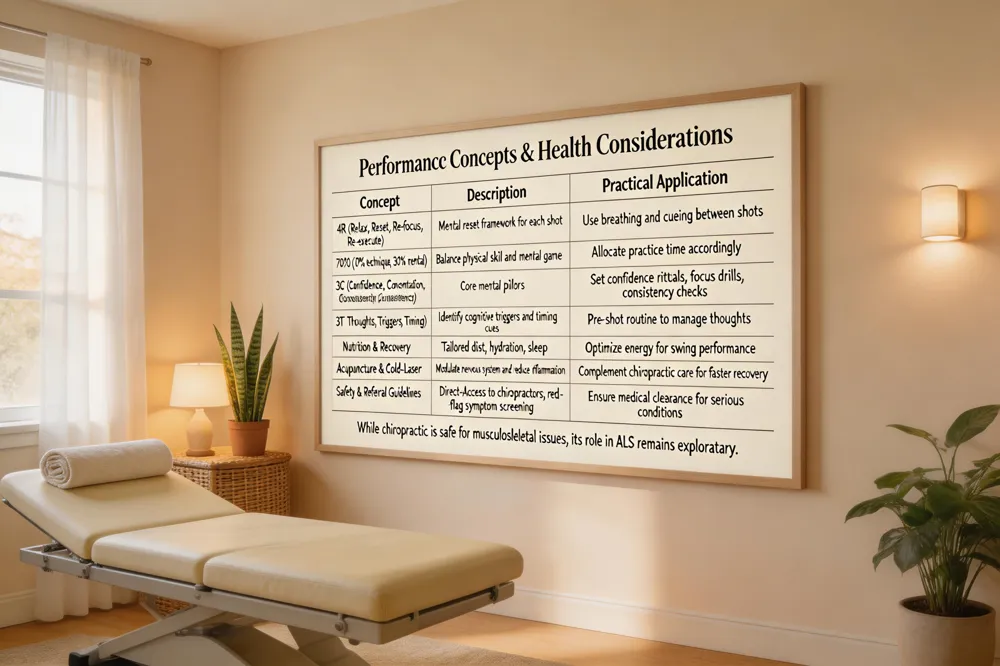 Mental and strategic frameworks such as the 4R (Relax, Reset, Re‑focus, Re‑execute), 70/30 (70 % technique, 30 % mental), 3C (Confidence, Concentration, Consistency) and 3T (Thoughts, Triggers, Timing) give golfers a structured approach to stay present, manage stress, and translate physical gains into on‑course results. Beyond musculoskeletal care, golfers benefit from modalities that address the nervous system, nutrition, and stress management—acupuncture, cold‑laser therapy, and personalized nutrition counseling can enhance recovery and overall well‑being. Safety and referral guidelines are straightforward: most states, including Colorado, allow direct‑access visits to chiropractors without a physician referral, and the American Chiropractic Association recommends a thorough medical intake before initiating care; patients with red‑flag symptoms should be referred to a medical doctor.
Can chiropractic help ALS? While chiropractic is safe for musculoskeletal symptoms, specific research on ALS is lacking, so its role remains exploratory.
Acupuncture Glenwood Springs Offered at 900 A Cooper Ave, sessions combine gentle needle placement with energetic reading for pain, digestion, stress, and tension‑type headaches; fees range $45‑$95 with optional pin‑free readings.
Anna Bernstein Glenwood Springs CO Dr. Bernstein, a board‑certified chiropractor, provides spinal adjustments, acupuncture, cold‑laser, soft‑tissue work, and nutritional counseling at 900 A Cooper Ave; office hours are M‑F 10 am‑5 pm (shorter Thu‑Fri).
Backcountry Chiropractic Glenwood Springs Located at 2425 Grand Ave Ste 105, Dr. Blake McDonald’s team offers adjustments, deep‑tissue massage, stretching, and PT‑based care; they accept major insurances and provide free parking.
Putting It All Together: Your Path to Better Golf and Health
A TPI Golf Assessment identifies the specific mobility, stability, and strength deficits that limit swing efficiency and increase injury risk. By quantifying hip rotation, thoracic spine flexibility, core control, and shoulder range of motion, the assessment creates a clear, data‑driven roadmap for improvement. Chiropractic care dovetails with those findings: precise spinal adjustments restore joint alignment, reduce nerve irritation, and unlock restricted rotations—especially in the thoracic spine and hips—while soft‑tissue work eases muscular tension that masks movement faults. Together, the TPI screen and targeted chiropractic interventions produce faster gains in swing speed, consistency, and pain‑free play. For golfers in Glenwood Springs and beyond, the next step is to schedule a certified TPI assessment at a local chiropractic clinic, review the personalized scorecard, and begin a combined program of adjustments, corrective exercises, and regular re‑screenings every 6–12 months to sustain performance and protect long‑term health.