Why Metrics Matter
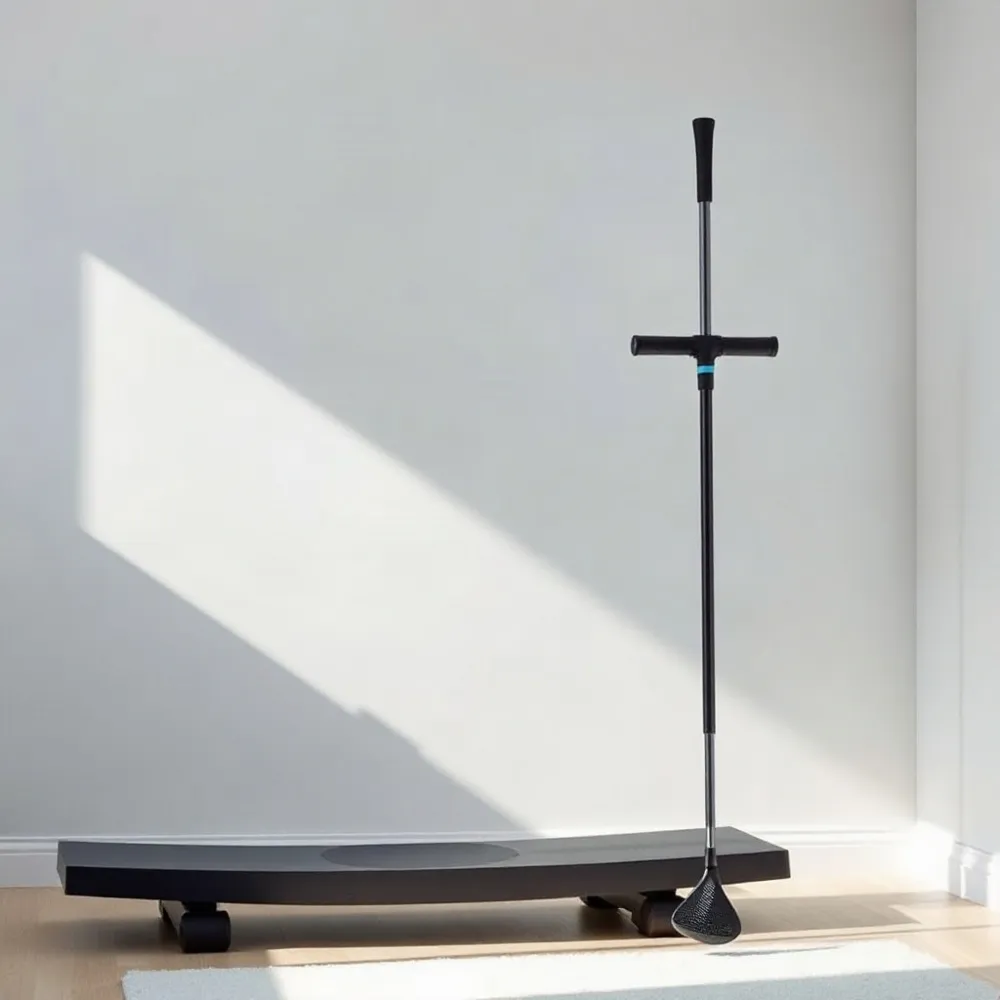
Tracking key swing and physical metrics gives golfers a clear picture of how their game is evolving. By logging clubhead speed, launch angle, smash factor, and TPI‑derived mobility scores, players can spot patterns that affect distance, accuracy and consistency. The same data highlights movement limitations that predispose to low‑back pain, golfer’s elbow or shoulder strain, allowing clinicians to prescribe targeted chiropractic adjustments and corrective exercises before injury sets in. A data‑driven practice routine—recording start line, dispersion and contact quality each session—creates a feedback loop that turns vague feelings into measurable goals, accelerates progress, and reduces wasted practice time. Over weeks, comparing these numbers against personal baselines or tour‑professional benchmarks reveals whether training interventions are paying off, reinforcing confidence and guiding future coaching decisions.
Understanding the TPI Golf Assessment
| Attribute | What It Measures | Why It Matters |
|---|---|---|
| Rotational Flexibility | Ability to rotate thoracic spine and hips | Influences swing length and clubhead speed |
| Hip Mobility | Range of motion in hip joints | Affects stance stability and power transfer |
| Core Stability | Ability to maintain trunk control | Prevents excessive torso sway and protects spine |
| Shoulder Stability | Control of glenohumeral joint | Ensures consistent clubface orientation |
| Overall Balance | Weight distribution during swing phases | Reduces injury risk and improves shot consistency |
| Ground‑Reaction Forces | Force applied to the ground during swing | Reveals power generation and potential overload |
| Video Swing Analysis | Visual assessment of swing mechanics | Highlights technical flaws for targeted correction |
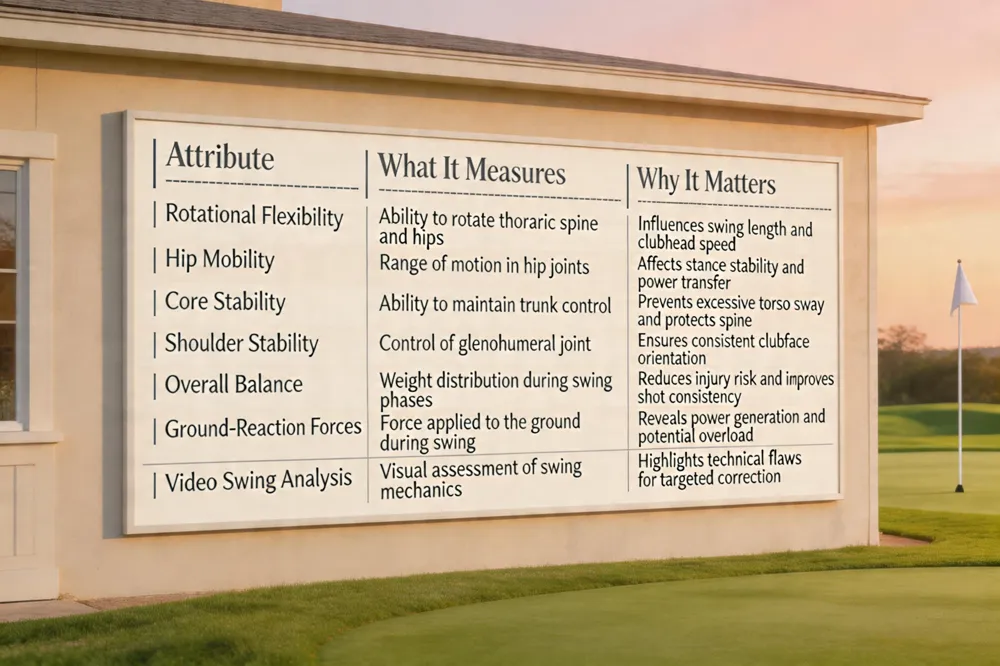 The Titleist Performance Institute (TPI) golf assessment is a science‑based screening that evaluates a golfer’s functional movement, mobility, strength, balance, and stability. By quantifying attributes such as rotational flexibility, hip mobility, core stability, shoulder stability, and overall balance, the screen pinpoints physical limitations that can compromise swing mechanics, reduce clubhead speed, and increase injury risk.
What is a TPI golf assessment? A TPI assessment is a comprehensive physical screen that measures key attributes—flexibility, strength, balance, and stability—to identify strengths and deficits that directly affect swing efficiency and injury risk. The data guide customized training programs, improve mobility, power, and consistency on the course.
Titleist TPI assessment The Titleist TPI assessment is a 10‑minute, evidence‑based screening that also captures ground‑reaction forces and video swing analysis. Our Glenwood Springs chiropractic clinic is a certified TPI provider, allowing us to translate screen results into personalized chiropractic adjustments, therapeutic exercises, and mobility work that enhance swing mechanics and prevent pain.
TPI assessment near me Located in Glenwood Springs, CO, our clinic offers on‑site TPI screenings performed by a TPI‑certified PT Dr. Tyler Meyers. The service includes a functional movement exam, video analysis, and a corrective plan that may incorporate fitness training, physical therapy, and swing coaching. Scheduling is simple—call or book online—to receive a data‑driven, non‑invasive approach that boosts performance while protecting musculoskeletal health.
Injury Prevention: Exercises and Strategies
| Exercise | Sets / Reps / Duration | Primary Benefit |
|---|---|---|
| Thoracic Rotations | 2 sets × 10‑15 reps each side | Improves swing plane flexibility |
| Hip Flexor Stretch | 2 sets × 30 s each side | Increases hip extension range |
| Core Activation (Bird‑Dog, Dead‑Bug) | 2 sets × 12 reps | Enhances trunk stability |
| Scapular Retraction (Band) | 2 sets × 15 reps | Strengthens shoulder girdle forer control |
| Glute Bridges | 3 sets × 15 reps | Boosts hip extension power and pelvis stability |
| Wrist Extensors Stretch | 2 sets × 20 s each side | Reduces forearm strain and improves grip handling |
| Dynamic Warm‑up (shoulders, spine, hips, legs) | 5‑10 min | Prepares muscles and joints for rotational forces |
| Strength Training (row, pull‑down, yoga, Pilates) | 2‑3 sessions/week | Builds endurance in core, lower back, forearms |
| Supportive Footwear & Light Bag/Cart | Ongoing | Lessens ankle, knee, hip impact |
| Routine Chiropractic Adjustments | Every 4‑6 weeks | Maintains joint mobility and early injury detection |
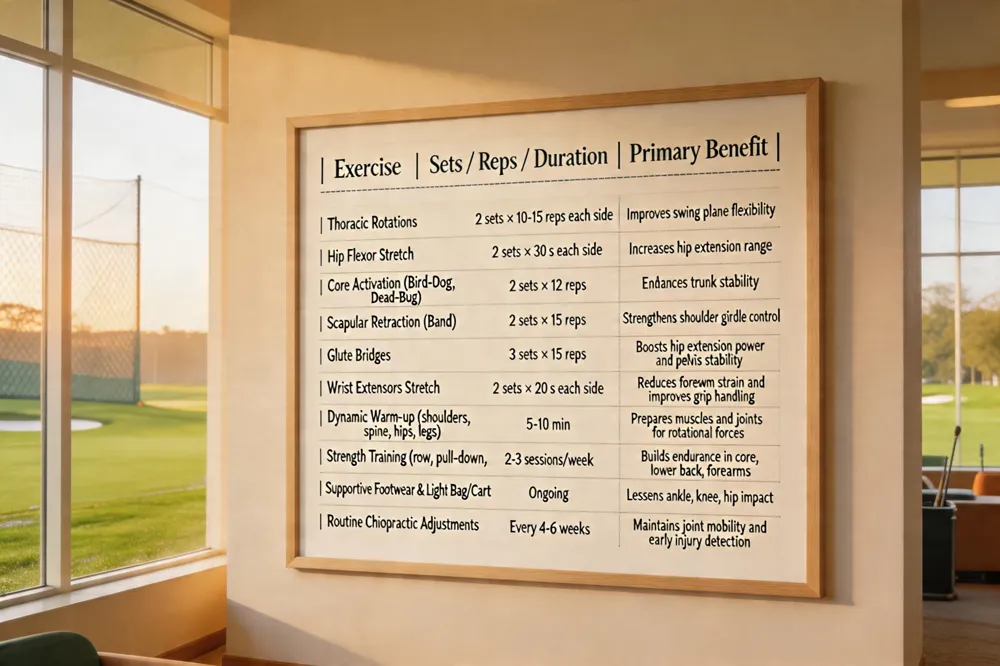 Golf injury prevention exercises
- Thoracic rotations – 10‑15 reps each side.
- Hip flexor stretch – hold 30 seconds each side.
- Core activation (bird‑dog, dead‑bug) – 2 sets of 12 reps.
- Scapular retraction with resistance band – 2 sets of 15 reps.
- Glute bridges – 3 sets of 15 reps.
- Wrist extensors stretch – hold 20 seconds each side. These movements improve mobility, strengthen stabilizers, and help the body handle the repetitive rotational forces of a golf swing.
How can golf injuries be prevented? Start with a dynamic warm‑up that mobilizes shoulders, thoracic spine, hips, and legs. Follow with a short range‑session, beginning with wedges and progressing to longer clubs. Strengthen core, lower back, and forearm muscles through rowing, pull‑downs, yoga, or Pilates to enhance stability and reduce overuse strain. Use supportive footwear and a light bag or cart to lessen ankle, knee, and hip stress. Maintain proper swing mechanics—keep the spine vertical in the follow‑through and avoid excessive torque. Schedule routine chiropractic adjustments and soft‑tissue therapy to keep joints mobile, release muscle tension, and catch early signs of trouble.
Is golf bad for hip impingement? Golf’s repetitive rotational forces can aggravate existing hip impingement, especially with poor mechanics or inadequate warm‑up, increasing friction between the femoral head and acetabulum. However, the sport is not inherently harmful if you preserve hip flexibility, strengthen surrounding muscles, and modify the swing to respect your range of motion. Regular chiropractic or physical‑therapy assessments and targeted corrective exercises can reduce joint stress, allowing you to play safely while managing impingement.
Swing Analysis: Data‑Driven Insights
| Metric | Definition | Impact on Performance |
|---|---|---|
| Clubhead Speed | Speed of the club at impact (mph) | Primary driver of distance; 1 mph ≈ 2‑3 yds gain |
| Smash Factor | Ball speed ÷ Clubhead speed | Indicates quality of contact; higher = more efficient energy transfer |
| Launch Angle | Vertical angle of ball launch (degrees) | Determines carry distance and trajectory; optimal varies by club |
| Face Angle | Angle of clubface relative to target at impact | Controls ball direction; mis‑alignment causes slices/hook |
| Club Path | Direction of club travel relative to target line | Works with face angle to shape shot flight |
| Tempo (Back‑to‑Downswing Ratio) | Timing ratio, usually 3:1 | Consistent tempo supports repeatable swing mechanics and higher smash factor |
| Rotational Power | Measured via ground‑reaction forces and hip rotation speed | Drives clubhead speed and distance |
| Balance Score | Weight shift symmetry during swing | Affects shot consistency and reduces injury risk |
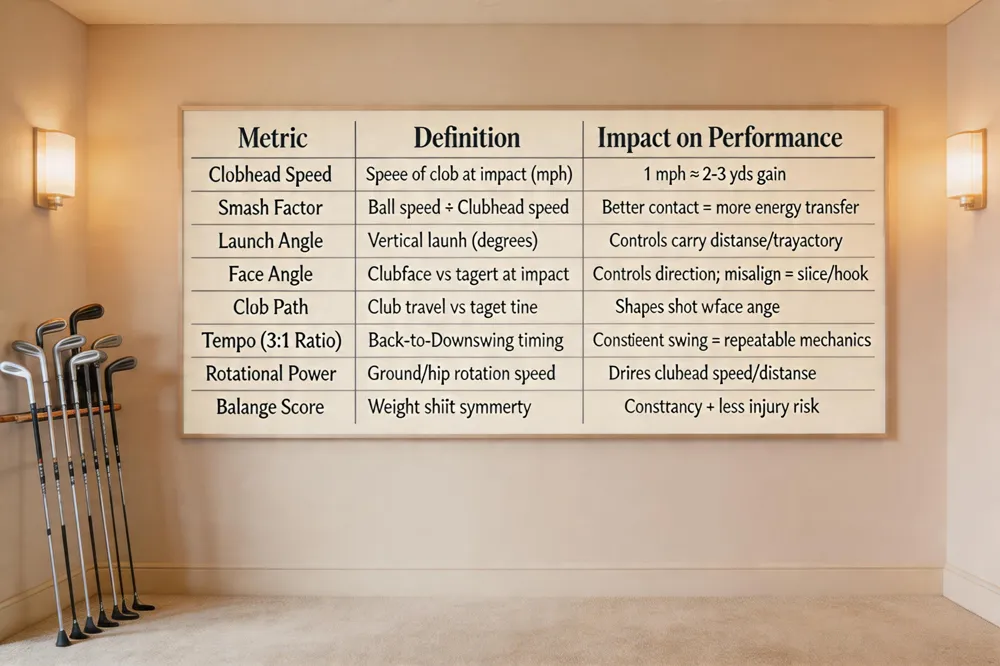 Modern swing analysis turns every golf shot into measurable data. Clubhead speed is the primary driver of distance; a 1 mph increase can add 2–3 yards, but only when the smash factor—ball speed divided by clubhead speed—is high, indicating solid, centered contact. Launch angle works hand‑in‑hand with speed; optimal vertical angles vary by club and swing speed, shaping carry distance and trajectory. Face angle and club path together explain the ball’s initial direction and shape; a square face on a neutral path yields straight shots, while mismatches cause slices, hooks, draws, or fades. Finally, tempo—the backswing‑to‑downswing ratio, typically 3:1—governs timing and energy transfer, and a consistent tempo supports a high smash factor and repeatable performance.
Is a golf swing analysis worth it? Yes. Data‑driven feedback isolates inefficiencies that strain the spine, hips, and shoulders. When paired with chiropractic care, the analysis guides targeted adjustments, mobility work, and strengthening to reduce joint stress, improve swing consistency, and prevent injury. The result is better scores, fewer aches, and a healthier game.
What is a TPI injection? A TPI (trigger‑point injection) delivers a small amount of local anesthetic, with or without a corticosteroid, directly into a tight muscle knot. By quickly reducing pain and tension, it restores range of motion, allowing patients to engage more fully in chiropractic adjustments, physical therapy, and corrective exercises. This minimally invasive option is especially useful for myofascial pain in the neck, shoulders, back, hips, or legs when conservative care alone is insufficient.
Advanced TPI Training & Medical Integration
| Component | Role in Golf Performance |
|---|---|
| 16‑Point Movement Screen | Identifies specific mobility, strength, and stability deficits |
| Chiropractic Adjustments | Restores joint alignment and improves range of motion |
| Trigger‑Point Injections | Reduces localized myofascial pain to enable full motion during training |
| Individualized Exercise Programs | Targets identified deficits with sport‑specific drills |
| Explosive Rotational Strength Training | Enhances power generation for higher clubhead speed |
| Dynamic Balance Drills | Improves stability during weight shift and swing phases |
| Repeat TPI Screenings | Tracks progress, refines training plan, and ensures continued efficiency |
| Integrated Swing Coaching | Aligns biomechanical data with technical swing adjustments |
| Soft‑Tissue Therapy (massage, myofascial release) | Maintains muscle health and prevents overuse injuries |
| Data‑Driven Feedback Loop | Uses screen results and swing metrics to continuously optimize performance |
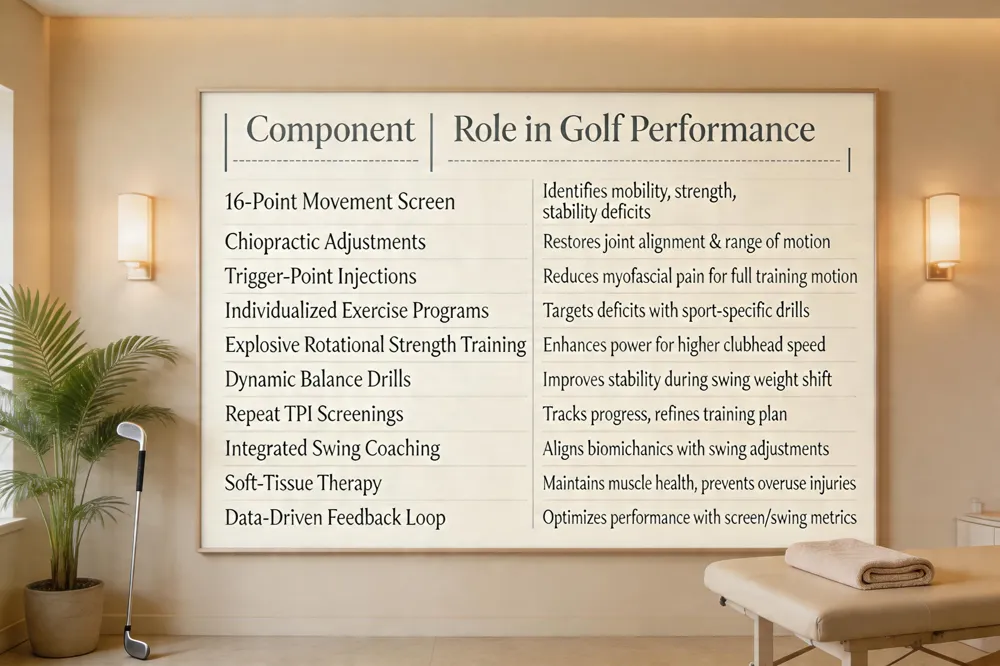 In practice, a TPI‑certified chiropractor combines the 16‑point movement screen with hands‑on adjustments, trigger‑point injections, and individualized exercise programs. Trigger‑point injections can address localized myofascial pain that limits hip rotation or core stability, while performance‑focused rehab emphasizes explosive strength, rotational power, and dynamic balance to translate biomechanical gains into on‑course results. This integrated approach allows golfers to track progress through repeat TPI screenings, adjust training plans, and maintain optimal swing efficiency with minimal injury risk.
Putting It All Together
To maximize performance and stay injury‑free, golfers should consistently track the five key metrics identified by leading assessments: clubhead speed, swing plane consistency, rotational flexibility, core stability, and balance. By pairing a TPI movement screen with chiropractic evaluation, clinicians can pinpoint mobility deficits, adjust joint alignment, and prescribe corrective exercises that translate directly into smoother swings and higher clubhead speed. The most effective plan combines chiropractor‑directed mobility drills—targeting hip rotation, thoracic spine, and shoulder girdle—with progressive strength work for the core and lower body. Maintaining this routine, reassessing every six to twelve weeks, ensures measurable progress and swing health.