Why Massage Matters for Your Body
Massage therapy—whether deep‑tissue, myofascial release, or trigger‑point work—applies sustained mechanical pressure to muscles, fascia, and connective tissue. This pressure stimulates mechanoreceptors, prompting the release of serotonin, dopamine, and endorphins that calm the nervous system and reduce pain perception. It also enhances blood and lymphatic circulation, delivering oxygen and nutrients while flushing metabolic waste (e.g., lactic acid) and decreasing inflammation. In a chiropractic setting, massage prepares tight musculature for precise adjustments, improves joint range of motion, and supports spinal alignment, creating a synergistic effect that accelerates recovery from back pain, sports injuries, and mobility deficits. The combined physiological response—neurochemical relaxation, improved microcirculation, and reduced muscle stiffness—underlies the holistic, patient‑centered benefits of integrating massage with chiropractic care.
Broad Spectrum Benefits of Massage
Key Benefits Overview
| Benefit Category | Primary Effects |
|---|---|
| Circulation | Increases oxygen & nutrient delivery; removes metabolic waste (e.g., lactic acid) |
| Neurochemical | Lowers cortisol; boosts serotonin, dopamine, endorphins, oxytocin |
| Musculoskeletal | Enhances flexibility, range of motion, balance, joint stability; aids injury prevention & recovery |
| Lymphatic | Improves drainage, reduces swelling |
| Sleep & Immunity | Improves sleep quality; supports immune function |
| Mental Health | Reduces stress, anxiety, depression |
Tables are presented in markdown format for easy integration into the article.
 20 Benefits of Massage
Massage therapy improves circulation, delivering oxygen and nutrients while removing metabolic waste such as lactic acid, which reduces inflammation and accelerates tissue repair. It lowers cortisol and boosts serotonin, dopamine, and endorphins, easing stress, anxiety, and depression. Regular sessions enhance flexibility, range of motion, balance, and joint stability, supporting injury prevention and faster recovery after sport or surgery. Improved lymphatic drainage reduces swelling, and enhanced proprioception promotes better posture and coordination. Overall, massage contributes to better sleep, immune function, and quality of life.
20 Benefits of Massage
Massage therapy improves circulation, delivering oxygen and nutrients while removing metabolic waste such as lactic acid, which reduces inflammation and accelerates tissue repair. It lowers cortisol and boosts serotonin, dopamine, and endorphins, easing stress, anxiety, and depression. Regular sessions enhance flexibility, range of motion, balance, and joint stability, supporting injury prevention and faster recovery after sport or surgery. Improved lymphatic drainage reduces swelling, and enhanced proprioception promotes better posture and coordination. Overall, massage contributes to better sleep, immune function, and quality of life.
Massage Therapy Benefits By stimulating mechanoreceptors, massage triggers pain‑modulating neurotransmitters and promotes vasodilation, leading to short‑term relief of low‑back, neck, and shoulder pain. The increased blood and lymph flow aids removal of waste products, while the parasympathetic activation reduces muscle tension and improves mobility. Mentally, the relaxation response mitigates stress‑related hormones, fostering a calmer, more energized state.
Massage Benefits for Women Women experience notable reductions in menstrual‑related cramping, hormonal‑linked tension, and post‑exercise soreness due to enhanced circulation and fascia‑release. The hormonal milieu (estrogen) often yields quicker tissue pliability, allowing deeper work with less post‑massage discomfort. Additionally, massage lowers cortisol and raises oxytocin, supporting sleep quality, mood stability, and immune resilience, which are especially valuable during hormonal fluctuations.
Targeted Clinical Insights & Safety
Clinical Safety Summary
| Topic | Guidance |
|---|---|
| Post‑Surgical | Delay massage until surgeon clearance; use light Swedish or lymphatic strokes; avoid deep pressure until tissue healing confirmed |
| Contraindicated Areas | Anterior/posterior neck triangles, suprasternal notch, sternum, axilla, umbilical region, inguinal angle, popliteal fossa |
| Side Effects | Mild soreness (24‑48 h), occasional bruising, transient fatigue; rare nerve irritation (tingling) |
| Recovery | Hydration, gentle movement, avoid heavy exercise for 12 h |
| Session Length | 30 min for focused relief; 45‑60 min for broader musculoskeletal issues; may combine with chiropractic adjustments |
Use this table to quickly reference safety considerations.
 Post‑surgical considerations: After procedures such as lymph node removal, massage can be beneficial but must be delayed until the surgeon clears the patient. In the early weeks the client should lie on the back, avoiding pressure on the incision, underarm, or any implanted devices. Light techniques—gentle Swedish strokes or soft lymphatic drainage—are permissible; deep‑tissue pressure is contraindicated until tissue healing is confirmed.
Contraindicated body areas: Deep pressure should never be applied to the anterior and posterior neck triangles, suprasternal notch, sternum, axilla, umbilical region, inguinal (groin) angle, and popliteal fossa because of vital vessels, nerves, and lymph nodes.
Side effects and recovery timeline: Deep‑tissue massage commonly leaves mild soreness for 24‑48 hours, occasional bruising, or transient fatigue as metabolic waste is cleared. Rarely, excessive pressure can irritate nerves, causing tingling. Recovery is typically rapid—hydration, gentle movement, and avoiding heavy exercise for 12 hours aid restoration.
Common queries: A 30‑minute session suffices for focused, short‑term relief (e.g., a single trigger point), but broader musculoskeletal issues usually require 45‑60 minutes and may be combined with chiropractic adjustments for optimal outcomes.
Performance, Recovery, and Athletic Applications
Athletic Application Guidelines
| Parameter | Recommendation |
|---|---|
| Frequency | General wellness: every 4‑6 weeks; chronic pain: every 1‑2 weeks; athletes: weekly or bi‑weekly |
| Physiological Effects | ↑ peripheral nerve stimulation → ↓ nociception; ↑ local blood & lymph flow → ↓ inflammation & swelling |
| Performance Benefits | Greater joint ROM, improved flexibility, reduced injury risk, better sleep, enhanced immune function |
| Hypertrophy Support | Not direct, but reduces soreness & adhesions, enabling higher‑quality training |
Summarizes how massage integrates into training cycles.
 Sports massage triggers several physiological responses that aid both recovery and performance. Mechanical pressure stimulates peripheral nerve receptors, dampening nociceptive signals and relaxing muscle fibers, while kneading and friction increase local blood flow. This enhanced circulation delivers oxygen and nutrients, flushes metabolic waste such as lactic acid, and promotes lymphatic drainage, thereby reducing inflammation and swelling. The net effect is greater joint range of motion, improved flexibility, and a lower risk of injury during subsequent activity.
For deep‑tissue massage, frequency should match the client’s goals. General wellness benefits from sessions every 4–6 weeks; chronic pain or persistent tension may require 1–2 weeks; athletes and highly active individuals often see optimal results with weekly or bi‑weekly treatments, especially during intensive training or rehabilitation phases.
While deep‑tissue massage does not directly induce hypertrophy, it creates a supportive environment for muscle growth by decreasing soreness, breaking down adhesions, and allowing more consistent, higher‑quality training. Over the long term, regular deep‑tissue massage reduces chronic pain, improves flexibility in the lumbar, knee, and shoulder regions, lowers blood pressure, enhances immune function, and promotes better sleep—all of which contribute to sustained athletic performance and injury prevention.
Integrating Massage with Chiropractic and Physical Therapy
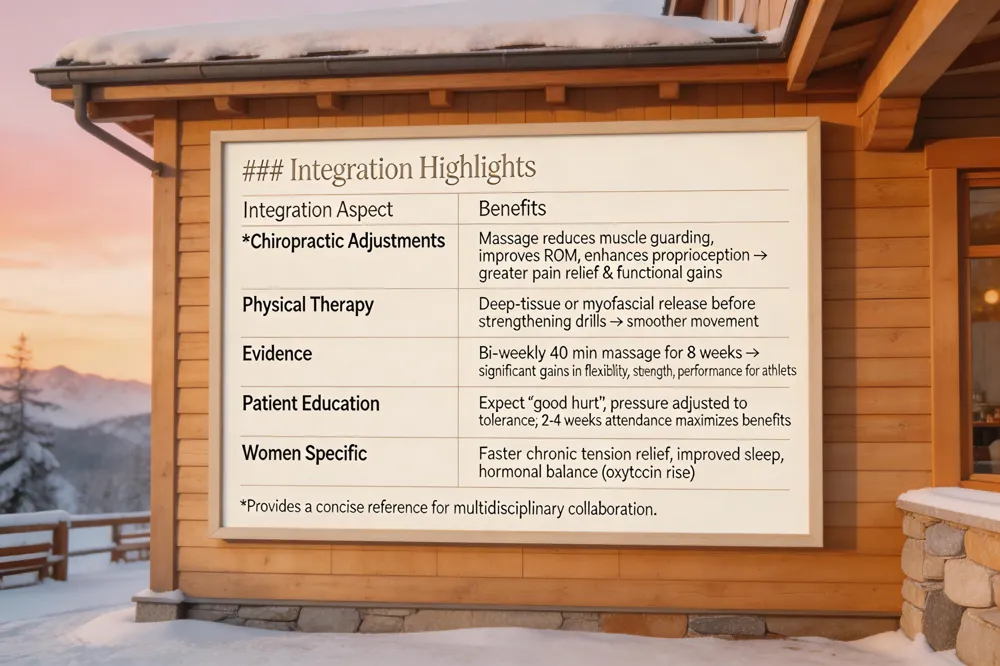
Integration Highlights
| Integration Aspect | Benefits |
|---|---|
| Chiropractic Adjustments | Massage reduces muscle guarding, improves ROM, enhances proprioception → greater pain relief & functional gains |
| Physical Therapy | Deep‑tissue or myofascial release before strengthening drills → smoother movement, fewer compensations |
| Evidence | Bi‑weekly 40 min massage for 8 weeks → significant gains in flexibility, strength, performance for team/strength athletes |
| Patient Education | Expect “good hurt”; pressure adjusted to tolerance; consistent attendance (2‑4 weeks) maximizes benefits |
| Women Specific | Faster chronic tension relief, improved sleep, hormonal balance (oxytocin rise) |
Provides a concise reference for multidisciplinary collaboration.
 Synergy with Adjustments
Massage prepares soft tissue for spinal manipulation by reducing muscle guarding, improving range of motion, and enhancing proprioceptive feedback. When combined with chiropractic adjustments, patients experience greater pain relief and faster functional gains.
Physical Therapy Coordination
Therapists schedule deep‑tissue or myofascial release sessions before strengthening drills, allowing smoother movement patterns and reducing compensatory strains. Regular bi‑weekly massage (40 min) over eight weeks has shown statistically significant improvements in flexibility, strength, and performance, especially for team and strength athletes.
Patient Education and Expectations
Clients should understand that short‑term relief for acute low‑back, neck, and shoulder pain, modest benefits for knee osteoarthritis, and systemic effects such as lowered cortisol and increased serotonin. Sessions may feel uncomfortable—often described as a "good hurt"—but therapists adjust pressure to tolerance. Consistent attendance (every 2–4 weeks) maximizes circulation, lymphatic drainage, and tissue repair, supporting long‑term musculoskeletal health.
Scientific Benefits of Massage
Evidence shows enhanced blood and lymphatic flow, reduced inflammatory mediators, and release of endorphins, serotonin, and dopamine, contributing to pain modulation, faster recovery, and improved mood.
Deep Tissue Massage in Physical Therapy
Targeting deeper muscle layers, it breaks down adhesions, increases nutrient delivery, and resets nervous system tension, enabling patients to perform therapeutic exercises with greater ease.
Deep Tissue Massage Benefits for Women
Women often experience quicker relief of chronic tension, improved sleep, and hormonal balance (e.g., oxytocin rise) due to estrogen‑mediated tissue pliability.
Long‑Term Benefits
Regular massage maintains joint flexibility, supports immune function, and sustains reductions in stress and pain, reducing injury risk over months.
Does Deep Tissue Massage Hurt?
It may cause mild discomfort in tight areas, described as a tolerable ache; therapists modify intensity on feedback, and post‑session soreness typically resolves within 24‑48 hours.
Practical Guidance for Glenwood Springs Residents
Local Practical Tips
| Recommendation | Reason |
|---|---|
| Hydration | Flush metabolic waste; counteract altitude‑induced dehydration |
| Compression Garments | Support microcirculation at 5,761 ft altitude |
| Post‑Massage Activity | Light stretching; avoid heavy lifting for 12 h; normal stiffness fades within 24 h |
| When to Seek Care | Persistent pain > 24 h warrants professional evaluation |
| Local Clinics | Glenwood Chiropractic & Mountain Shadows Chiropractic offer combined chiropractic‑massage services |
Tailored guidance for residents and visitors to Glenwood Springs.
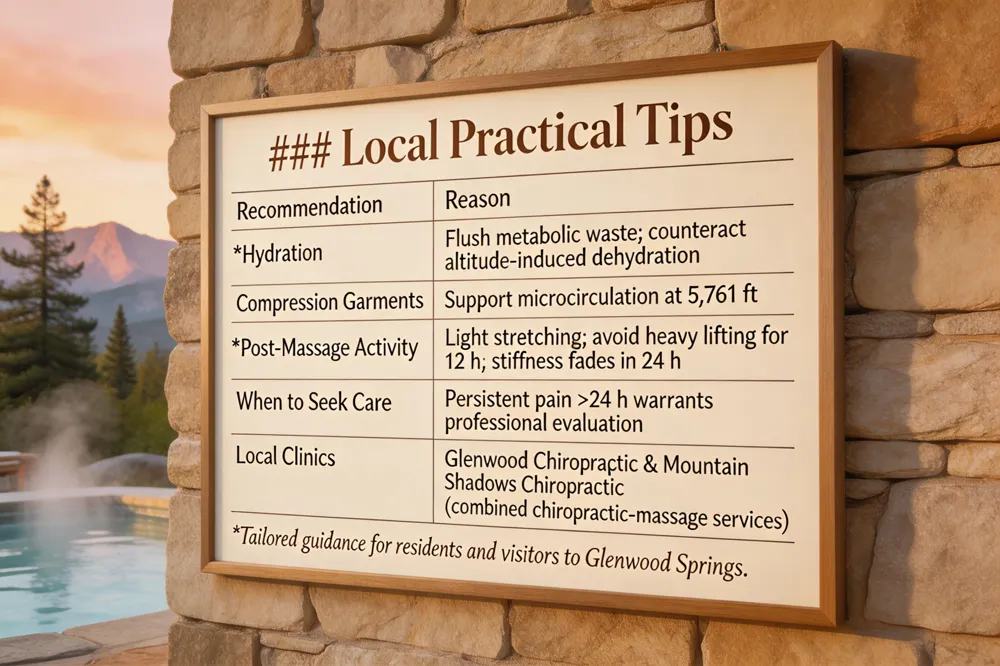 Local clinics such as Glenwood Chiropractic and Mountain Shadows Chiropractic combine chiropractic adjustments with deep‑tissue, myofascial release, and lymphatic drainage to improve circulation, break down adhesions, and support joint stability. At 5,761 ft altitude, reduced oxygen saturation can increase muscle fatigue; staying hydrated, maintaining aerobic activity, and using compression garments help preserve microcirculation. After a massage, most people experience normal stiffness that fades within 24 hours. Drink plenty of water to flush metabolic waste, avoid heavy lifting for 12 hours, and perform light stretching to aid circulation. Persistent pain beyond a day warrants professional evaluation.
Putting It All Together for Faster Healing
Deep‑tissue and other therapeutic massages boost blood and lymphatic flow, delivering oxygen, nutrients and waste‑removal to fatigued muscles while lowering cortisol and releasing endorphins. Improved microcirculation reduces inflammation, speeds tissue repair, and enhances joint proprioception, leading to greater stability and a quicker return to activity. When combined with chiropractic adjustments that correct spinal alignment, massage prepares soft tissue for manipulation, amplifying pain relief and mobility gains. Residents and visitors to Glenwood Springs are invited to experience this integrated, non‑invasive program at local clinics—schedule a consult today and accelerate your healing journey. Therapists tailor each session to your sport or injury.