Overview
Degenerative disc disease (DDD) is the age‑related loss of water and elasticity in intervertebral discs, causing reduced cushioning and disc height. As discs dehydrate, the spine’s ability to absorb shock diminishes, leading to chronic back or neck pain, stiffness, and sometimes radiating numbness when nerve roots are irritated. Because DDD is a mechanical‑inflammatory process rather than an infection, most patients achieve satisfactory relief through non‑surgical, multimodal care. Evidence‑based chiropractic adjustments, targeted physical‑therapy exercises, weight‑management, and adjunctive modalities such as acupuncture, massage, and spinal decompression address inflammation, improve spinal mechanics, and strengthen supporting musculature—all while avoiding the risks of surgery. This patient‑centered, holistic approach is especially valuable for individuals seeking lasting functional improvement with minimal adverse effects.
Understanding the Condition
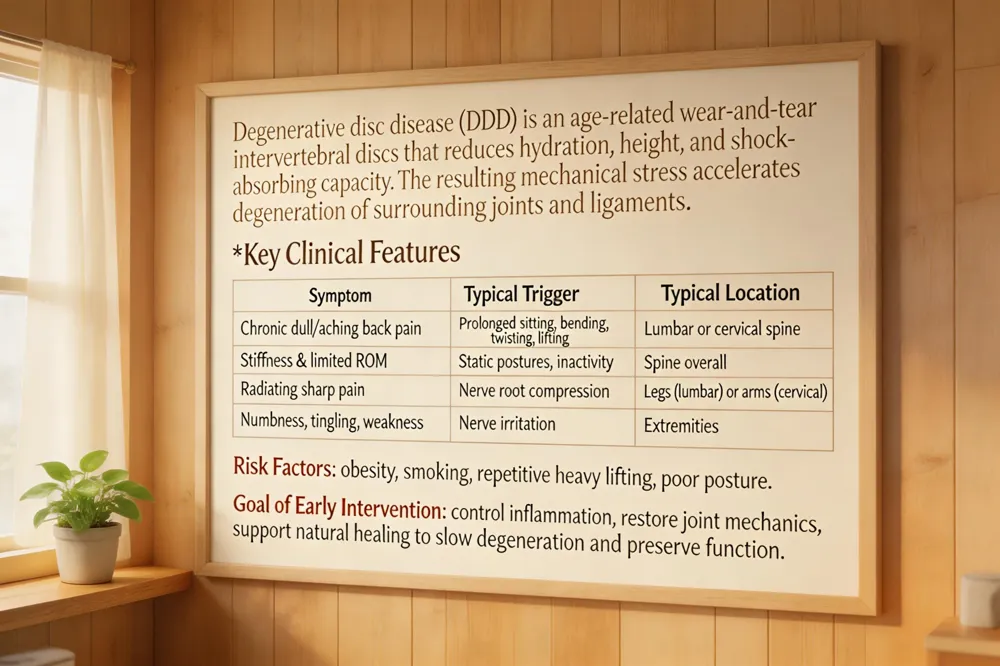
Degenerative disc disease (DDD) is an age‑related wear‑and‑tear of intervertebral discs that reduces hydration, height, and shock‑absorbing capacity. The resulting mechanical stress accelerates degeneration of surrounding joints and ligaments.
Key Clinical Features
| Symptom | Typical Trigger | Typical Location |
|---|---|---|
| Chronic dull/aching back pain | Prolonged sitting, bending, twisting, lifting | Lumbar or cervical spine |
| Stiffness & limited ROM | Static postures, inactivity | Spine overall |
| Radiating sharp pain | Nerve root compression | Legs (lumbar) or arms (cervical) |
| Numbness, tingling, weakness | Nerve irritation | Extremities |
Risk Factors: obesity, smoking, repetitive heavy lifting, poor posture.
Goal of Early Intervention: control inflammation, restore joint mechanics, support natural healing to slow degeneration and preserve function.
 Degenerative disc disease (DDD) originates from the natural, age‑related wear and tear of the intervertebral discs. Over time the disc nucleus loses water and proteoglycans, reducing hydration and elasticity; the disc flattens, loses height, and can develop fissures or herniations. This loss of shock‑absorbing capacity places greater mechanical stress on the surrounding vertebrae, facet joints, and ligaments, accelerating the degenerative cascade.
Typical symptoms reflect the loss of disc cushioning and the irritation of nearby nerve structures. Patients most often report chronic dull or aching back pain that worsens with prolonged sitting, bending, twisting, or lifting. Stiffness, limited range of motion, and occasional sharp, radiating pain down the legs (lumbar DDD) or arms (cervical DDD) are common. Numbness, tingling, or weakness may appear when nerve roots become compressed.
Progression is usually slow but can be hastened by risk factors such as obesity, smoking, repetitive heavy lifting, and poor posture. While many adults develop radiographic disc changes after age 40, only a minority become symptomatic. Early, patient‑centered interventions—targeted exercise, ergonomic education, and gentle chiropractic care—aim to control inflammation, restore joint mechanics, and support the spine’s natural healing processes, thereby slowing further degeneration and preserving function.
Lifestyle Modifications
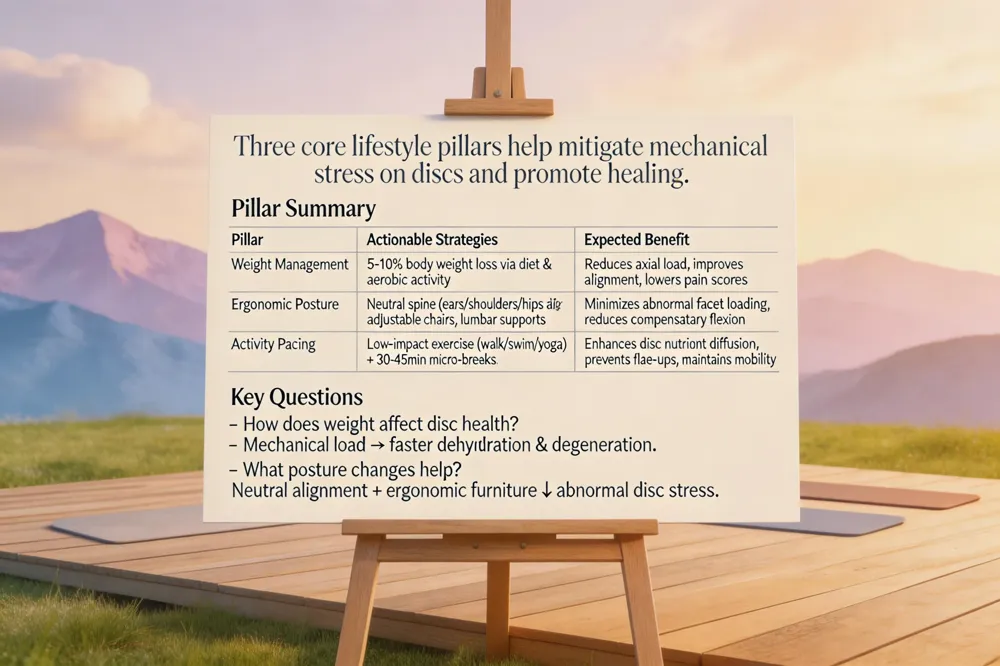
Three core lifestyle pillars help mitigate mechanical stress on discs and promote healing.
Pillar Summary
| Pillar | Actionable Strategies | Expected Benefit |
|---|---|---|
| Weight Management | Achieve modest weight loss (5‑10 % body weight) via diet & aerobic activity | Reduces axial load, improves alignment, lowers pain scores |
| Ergonomic Posture | Neutral spine (shoulders back, ears over shoulders, hips over knees); use adjustable chairs, lumbar supports, eye‑level monitor | Minimizes abnormal facet loading, reduces compensatory flexion |
| Activity Pacing | Low‑impact aerobic exercise (walking, swimming, yoga) + micro‑breaks every 30‑45 min | Enhances disc nutrient diffusion, prevents flare‑ups, maintains mobility |
Key Questions
- How does weight affect disc health? ↑ Mechanical load → faster dehydration & degeneration.
- What posture changes help? Neutral alignment + ergonomic furniture ↓ abnormal disc stress.
 Effective,‑surgical management of degenerative disc disease hinges on three core lifestyle pillars: weight management, ergonomic posture, and activity pacing.
Weight management – Excess body mass adds axial load to the lumbar and cervical spine, accelerating disc dehydration, loss of height, and subsequent degeneration. Studies from NYU Langone and the NIH emphasize that modest weight loss reduces spinal compression, improves alignment, and can lower pain scores by decreasing mechanical stress on the intervertebral discs.
Ergonomic posture – Maintaining a neutral spine—shoulders back, ears over shoulders, and hips over knees—minimizes abnormal facet loading. Ergonomic furniture (adjustable chairs, lumbar supports) and workstation set‑ups that keep the monitor at eye level and elbows close to the body reduce the need for compensatory flexion, thereby limiting disc strain.
Activity pacing – Rather than prolonged static positions or high‑impact activities, patients should intersperse low‑impact aerobic exercise (walking, swimming, yoga) with frequent micro‑breaks. This promotes circulation to the disc’s surrounding vasculature, supports nutrient diffusion, and prevents flare‑ups while preserving functional mobility.
Key questions
- How does weight affect disc health? Excess weight increases mechanical load on the spine, hastening disc dehydration and degeneration.
- What posture changes help? Neutral spine alignment and the use of ergonomic furniture reduce abnormal stress on discs and supporting structures.
Together, these modifications create a supportive environment that complements chiropractic adjustments, physical therapy, and other complementary therapies, fostering long‑term symptom control without surgery.
Physical Therapy and Exercise
Physical therapy focuses on core stability, flexibility, and low‑impact cardio to protect discs and improve function.
Exercise Protocol
| Exercise Type | Examples | Frequency | Rationale |
|---|---|---|---|
| Core Strengthening | Bird‑dog, modified planks, pelvic tilts | 2‑3 supervised PT sessions/week + daily home drills | Provides natural spinal brace, reduces disc load |
| Flexibility | Hamstring, hip‑flexor, thoracic spine stretches | Daily (10‑15 min) | Maintains disc height, prevents compensatory strain |
| Low‑Impact Cardio | Walking, swimming, stationary biking | 3‑5 sessions/week (20‑30 min) | Improves end‑plate circulation, nutrient delivery |
General Guidance: Consistency is key; combine supervised sessions with daily home practice for optimal pain reduction and functional gains.
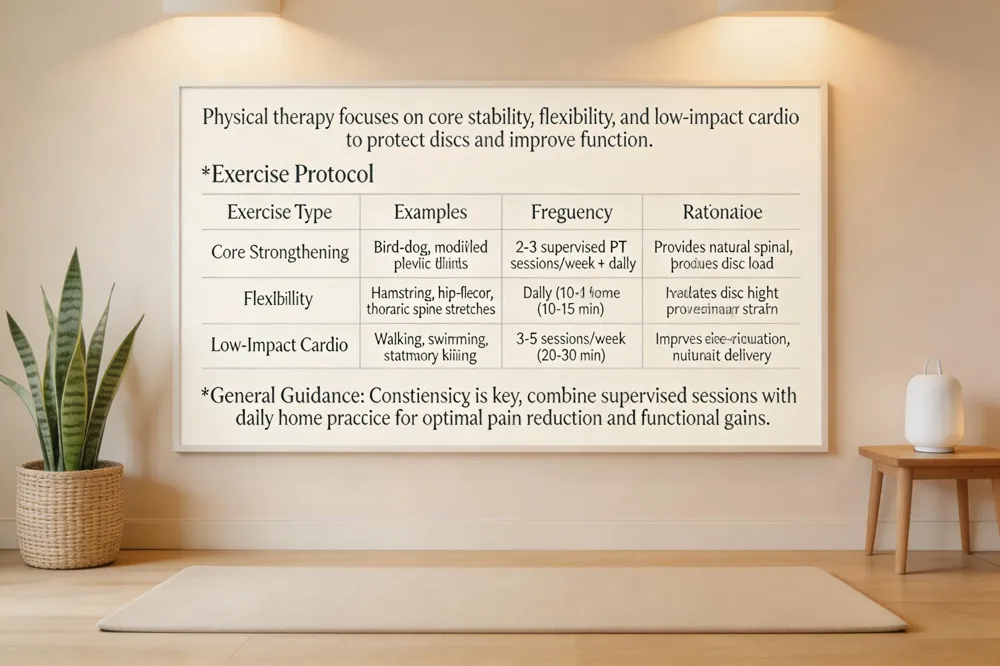 Physical therapy is a cornerstone of non‑surgical care for degenerative disc disease. Programs emphasize core strengthening, flexibility, and low‑impact aerobic activity to support spinal stability, improve range of motion, and reduce disc load.
Core‑strengthening drills such as bird‑dog, planks, and pelvic tilts target the deep abdominal and lumbar muscles that act as a natural brace for the spine. Flexibility work—gentle hamstring, hip‑flexor, and thoracic spine stretches—helps maintain disc height and prevents compensatory strain. Low‑impact cardio (walking, swimming, stationary biking) promotes circulation to the vertebral end‑plates, delivering nutrients essential for disc health without excessive axial loading.
Which exercises are safest?
Low‑impact activities like walking, swimming, and specific core‑strengthening drills (e.g., bird‑dog, modified planks, pelvic tilts) support spinal stability without excessive loading. These exercises avoid high‑impact forces that could exacerbate disc dehydration or aggravate nerve irritation.
How often should therapy be done?
A typical regimen involves 2–3 supervised physical‑therapy sessions per week, combined with daily home‑exercise routines. Consistency—performing core and flexibility drills each day—maximizes pain reduction and functional gains while allowing the discs time to re‑hydrate and the surrounding musculature to adapt.
Integrating these evidence‑based exercises with lifestyle modifications (weight management, ergonomic posture, smoking cessation) creates a holistic, patient‑centered approach that can lessen pain, improve mobility, and potentially slow further disc degeneration.
Alternative and Adjunct Therapies
Adjunct modalities can provide symptomatic relief and complement core rehab.
Adjunct Options
| Modality | Typical Use | Primary Benefit |
|---|---|---|
| Heat Therapy | Warm pack/shower 15‑20 min, 2‑3×/day during flare‑ups | Increases blood flow, relaxes paraspinal muscles, reduces spasm |
| Cold Therapy | Ice pack 10‑15 min, 2‑3×/day during acute inflammation | Blunts inflammation, numbs sharp pain |
| Therapeutic Massage | Myofascial release, trigger‑point work 1‑2×/week | Decreases muscle tension, improves circulation, enhances proprioception |
| Acupuncture | Needle stimulation 1‑2×/week | Modulates endogenous opioids & inflammatory pathways → pain reduction |
| Nutritional Supplements | Glucosamine, chondroitin, omega‑3 fatty acids (daily) | May support joint health & reduce stiffness (evidence mixed) |
FAQ
- Can heat or cold provide relief? Yes – heat relaxes muscles, cold reduces inflammation.
- Are supplements helpful? Potentially, especially when combined with weight management and aerobic activity, though scientific support varies.
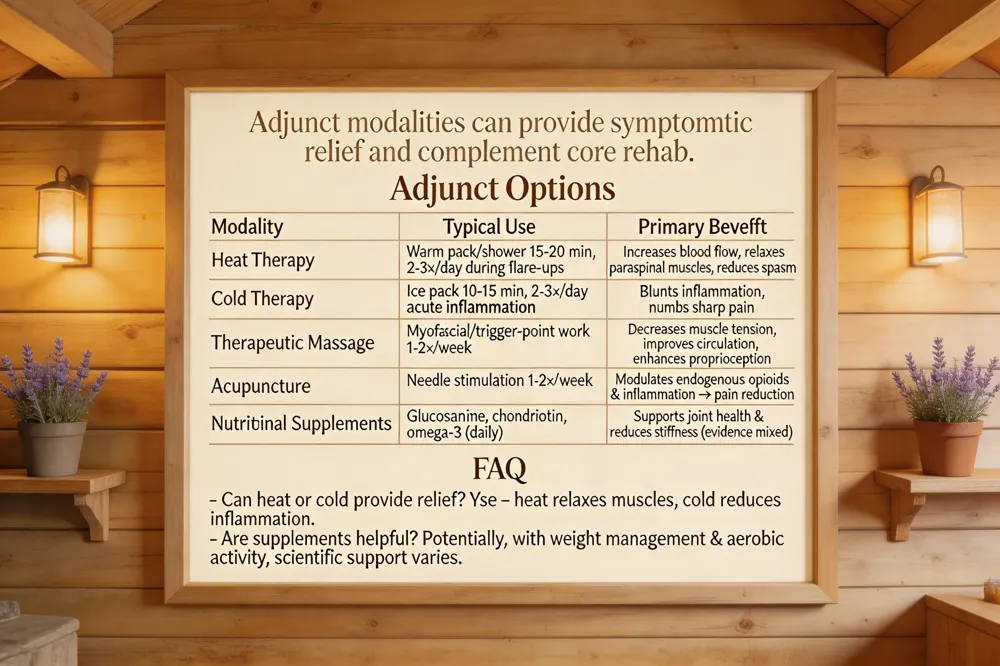 Heat and cold therapy are simple, low‑risk modalities that many clinicians recommend for degenerative disc disease. Applying a warm pack or taking a warm shower helps increase local blood flow, relax tight paraspinal muscles, and diminish muscle spasm, while a cold pack can blunt acute inflammation and numb sharp pain. Patients typically alternate the two during flare‑ups, and short‑term relief is well documented in clinical guidelines for low‑back pain.
Therapeutic massage, including myofascial release and trigger‑point work, is another cornerstone of non‑surgical care. By reducing muscle tension, improving circulation, and enhancing proprioception, massage can lessen nerve irritation secondary to disc degeneration. Studies on chronic back pain report modest pain reductions and improved functional scores when massage is combined with exercise and education.
Controlled trials have shown small‑to‑moderate decreases in pain intensity for chronic lumbar and cervical DDD, making it a valuable adjunct to physical therapy and chiropractic care.
Nutritional supplements such as glucosamine, chondroitin, and omega‑3 fatty acids are frequently used to support joint health. While the evidence is mixed, some patients report reduced stiffness and slower symptom progression, especially when paired with weight management and low‑impact aerobic activity.
Can heat or cold provide relief? Thermal therapy can reduce muscle tension and inflammation, offering temporary pain relief.
Are supplements helpful? Glucosamine, chondroitin, and omega‑3 fatty acids may support joint health, though evidence is mixed.
Putting It All Together
A successful DDD program blends lifestyle changes, targeted exercise, and evidence‑based therapies. Maintaining a healthy weight, quitting smoking, and using ergonomic workstations reduce axial load on degenerated discs, while low‑impact aerobic activities (walking, swimming, yoga) improve circulation and disc nutrition. Core‑strengthening and flexibility routines prescribed by physical therapists or chiropractors enhance spinal stability and limit further wear. Complementary modalities—spinal manipulation, flexion‑distraction, therapeutic massage, acupuncture, and TENS—provide short‑term pain relief and improve joint mechanics, allowing patients to stay active. Seek professional evaluation when pain persists beyond a few weeks, radiates with numbness or weakness, or interferes with daily function; early chiropractic or PT assessment can prevent progression and avoid surgery. When a coordinated, multimodal plan is followed, most patients experience sustained symptom reduction and functional improvement, with a low risk of serious adverse events and a favorable long‑term outlook.