Why Sport‑Specific Chiropractic Matters
Sports like tennis and football stress the body in distinct ways, so chiropractic care must be tailored to each sport’s injury patterns. Tennis players face repetitive overhead strokes and rapid directional changes that commonly produce shoulder impingement, rotator‑cuff strain, and lateral epicondylitis, whereas football athletes endure high‑impact collisions and sudden accelerations that lead to lumbar strain, knee ligament sprains, and ankle sprains. Precise spinal and joint alignment restores optimal nervous‑system signaling, improves range of motion, and enhances proprioception—key factors for a powerful serve or a swift cut block. Integrating soft‑tissue therapy, targeted rehabilitation, and modalities such as shockwave or PRP creates a multidisciplinary, non‑invasive pathway that accelerates healing, reduces medication reliance, and supports long‑term performance for both athletes and recovery.
Injury Profiles and Chiropractic Foundations
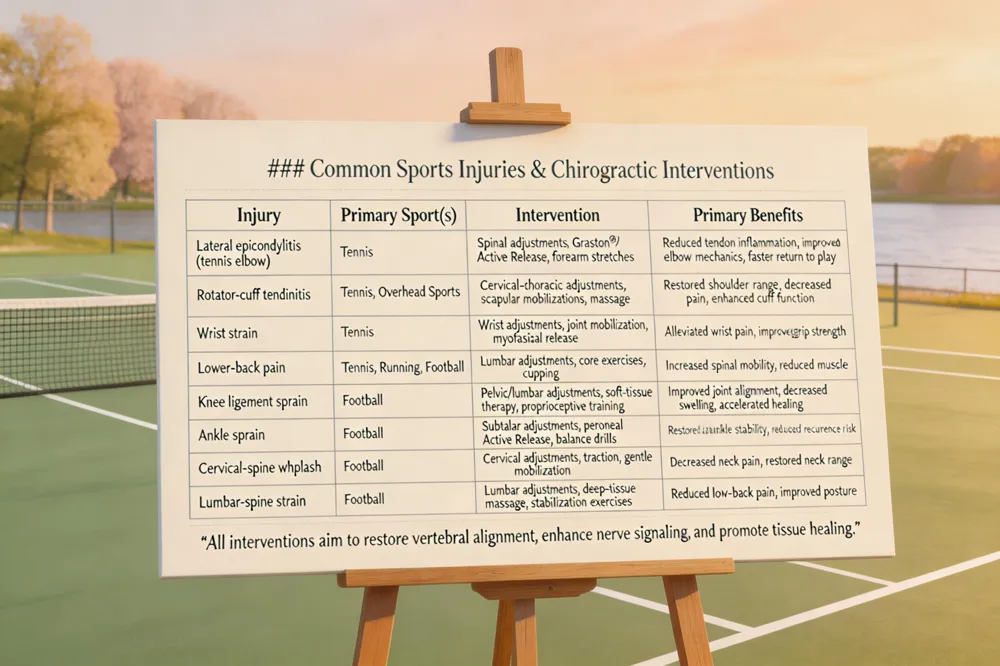
Common Sports Injuries & Chiropractic Interventions
| Injury | Primary Sport(s) | Typical Chiropractic Intervention | Primary Benefits |
|---|---|---|---|
| Lateral epicondylitis (tennis elbow) | Tennis | Spinal adjustments, Graston® or Active Release soft‑tissue work, forearm stretching | Reduced tendon inflammation, improved elbow mechanics, faster return to play |
| Rotator‑cuff tendinitis | Tennis, overhead sports | Cervical‑thoracic adjustments, scapular mobilizations, therapeutic massage | Restored shoulder range of motion, decreased pain, enhanced rotator‑cuff function |
| Wrist strain | Tennis | Wrist‑specific adjustments, joint mobilization, myofascial release | Alleviated wrist pain, improved grip strength |
| Lower‑back pain | Tennis, running, football | Lumbar adjustments, core stabilizing exercises, cupping | Increased spinal mobility, reduced muscle guarding |
| Knee ligament sprain | Football | Pelvic and lumbar adjustments, soft‑tissue therapy, proprioceptive training | Improved joint alignment, decreased swelling, accelerated healing |
| Ankle sprain | Football | Subtalar adjustments, active release of peroneal muscles, balance drills | Restored ankle stability, reduced recurrence risk |
| Cervical‑spine whiplash | Football | Cervical spine adjustments, cervical traction, gentle mobilization | Decreased neck pain, restored neck range of motion |
| Lumbar‑spine strain | Football | Lumbar adjustments, deep‑tissue massage, lumbar stabilization exercises | Reduced low‑back pain, improved posture |
All interventions aim to restore vertebral alignment, enhance nerve signaling, and promote tissue healing.
 Common overuse injuries in tennis – Repetitive serves cause lateral epicondylitis, rotator‑cuff tendinitis, wrist strain and lower‑back pain, often linked to limited spinal mobility and poor scapular mechanics.
Acute trauma patterns in football – Sudden cuts and tackles result in knee ligament sprains, ankle sprains, cervical‑spine whiplash and lumbar‑spine strain, creating joint irritation and muscle guarding.
Spinal manipulation and soft‑tissue therapy – Adjustments restore vertebral alignment, improving nerve signaling and joint range of motion. Instrument‑assisted soft‑tissue work (Active Release, Graston, cupping) releases adhesions, boosts circulation and reduces inflammation, accelerating repair for both tennis overuse and football trauma.
Shoulder players go to the chiropractor? – Yes. Regular adjustments keep spinal and joint alignment, increase flexibility, reduce stiffness and support nervous‑system efficiency, lowering injury risk and speeding recovery between practices and games.
Sports chiropractic research – Recent studies show sport‑specific chiropractic care improves performance, lowers injury rates and shortens return‑to‑play. International research and the International Federation of Sports Chiropractic are expanding evidence‑based protocols.
Running and chiropractic treatment – Chiropractic care corrects misalignments that hinder stride, reduces muscle tension and enhances neuromuscular coordination, helping runners prevent shin splints, IT‑band syndrome and knee pain while improving recovery.
In Glenwood Springshttps://sportspluspt.com/how-chiropractic-care-can-help-you-resolve-tennis-injuries/ circulation and hot springs complement chiropractic care, supporting tissue healing and performance for athletes.
Local Glenwood Springs Clinics: What They Offer
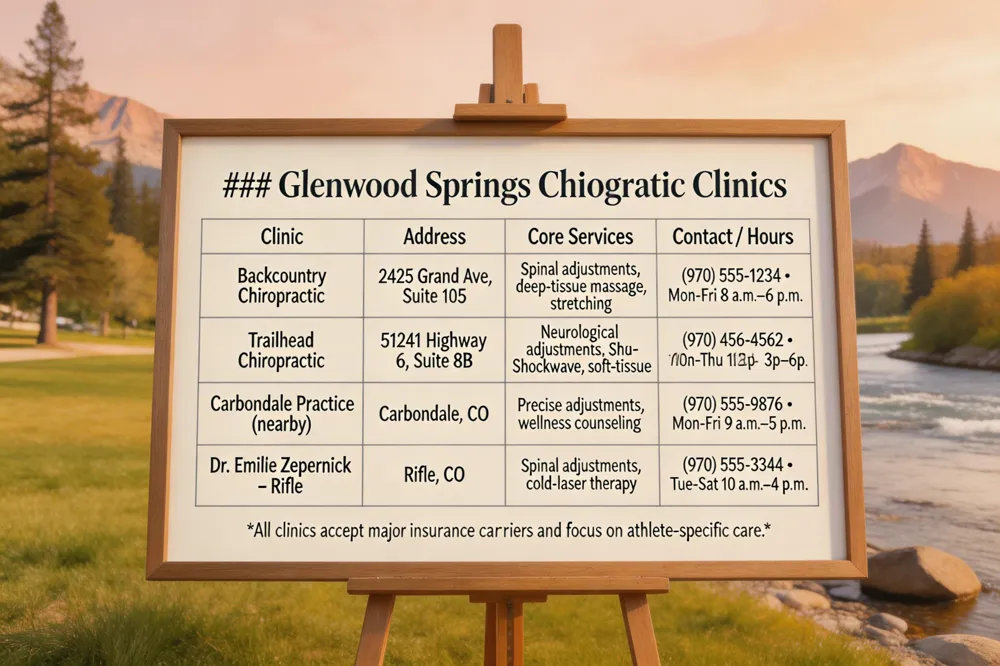
Glenwood Springs Chiropractic Clinics
| Clinic | Address | Core Services | Contact / Hours |
|---|---|---|---|
| Backcountry Chiropractic | 2425 Grand Ave, Suite 105 | Spinal adjustments, deep‑tissue massage, stretching, rehabilitative exercises | (970) 555‑1234 • Mon‑Fri 8 a.m.–6 p.m. |
| Trailhead Chiropractic | 51241 Highway 6, Suite 8B | Neurologically‑based adjustments, soft‑tissue therapies, Shockwave acoustic wave, active‑recovery plans | (970) 456‑4562 • Mon‑Thu 10 a.m.–12 p.m. & 3 p.m.–6 p.m. |
| Carbondale Practice (nearby) | Carbondale, CO | Precise adjustments, therapeutic exercises, wellness counseling | (970) 555‑9876 • Mon‑Fri 9 a.m.–5 p.m. |
| Dr. Emilie Zepernick – Rifle | Rifle, CO | Spinal adjustments, cold‑laser therapy, Activator Method | (970) 555‑3344 • Tue‑Sat 10 a.m.–4 p.m. |
All clinics accept major insurance carriers and focus on athlete‑specific care.
 Glenwood Springs athletes a range of patient‑centered chiropractic providers that blend evidence‑based adjustments with complementary modalities for athletes and active residents.
Backcountry Chiropractic – Located at 2425 Grand Avenue, Suite 105, Dr. Blake McDonald, DC, delivers non‑invasive musculoskeletal care including spinal adjustments, deep‑tissue massage, stretching, and rehabilitative exercises. The clinic treats back and neck pain, sciatica, whiplash, and sports‑related injuries, emphasizing personalized treatment plans and accepting major insurance carriers.
Trailhead Chiropractic – At 51241 Highway 6, Suite 8B, this family‑run practice employs neurologically‑based techniques to correct nerve interference. Services feature spinal adjustments, soft‑tissue therapies, softwave acoustic wave treatment, and active‑recovery plans for back, neck, migraines, and post‑injury rehab. Office hours are Monday‑Thursday, 10 a.m.–12 p.m. and 3 p.m.–6 p.m., with appointments via (970) 456‑4562.
Other Nearby Practices – Carbondale chiropractors provide precise adjustments, therapeutic exercises, and wellness counseling, while Dr. Emilie Zepernick in Rifle offers spinal adjustments, cold‑laser therapy, and Activator Method care. Both locations focus on pain relief, mobility restoration, and injury prevention for athletes throughout the Colorado mountain region.
Adjunct Modalities: From Acupuncture to Shockwave
Adjunct Modalities Overview
| Modality | Primary Indications | Typical Cost per Session | Typical Course (sessions) | Key Notes |
|---|---|---|---|---|
| Acupuncture | Acute back/neck/elbow pain, inflammation control | $70‑$120 | 1‑4 sessions for acute issues; monthly for maintenance | Fine needles stimulate points to modulate inflammation and promote parasympathetic response |
| Shockwave Therapy (Extracorporeal) | Chronic tendinopathies (tennis elbow, rotator‑cuff, plantar fasciitis, Achilles), stubborn hip/back pain | $150‑$300 | 3‑5 sessions | Often not covered; medical‑necessity letter may aid reimbursement; mild side effects (redness, soreness) |
| Cryotherapy (Cold‑induced inflammation control) | Post‑exercise inflammation, acute swelling | $30‑$50 per session | 5‑10 sessions as needed | Rapid reduction of edema, analgesic effect |
| Softwave Acoustic Therapy (Low‑energy) | Tissue healing, muscle soreness | $80‑$130 | 4‑6 sessions | Non‑invasive, stimulates cellular repair |
| Low‑Level Laser (Photobiomodulation) | Pain reduction, wound healing, inflammation | $60‑$100 | 5‑8 sessions | Enhances mitochondrial activity, painless |
These modalities are typically used in conjunction with chiropractic adjustments to maximize recovery.
 Acupuncture in Glenwood Springs is used as a complementary pain‑relief tool alongside chiropractic adjustments. Fine needles stimulate points that modulate inflammation, improve circulation and promote a parasympathetic state, often reducing acute back, neck or elbow discomfort within 1‑4 sessions. Shockwave therapy (extracorporeal shockwave) is indicated for chronic tendinopathies such as tennis elbow, rotator‑cuff tendinitis, plantar fasciitis and Achilles pain, as well as stubborn hip or back pain. A typical course consists of three to five brief sessions; each session costs $150‑$300, so the total out‑of‑pocket expense ranges from $450‑$1,500. Most insurers label shockwave experimental, so coverage is limited; a medical‑necessity letter may secure partial reimbursement for orthopedic indications. Side effects are usually mild—temporary redness, swelling, bruising or soreness—and resolve within days; rare complications include skin burns or nerve irritation if dosing is incorrect. Other non‑invasive options favored by Colorado athletes include cryotherapy (cold‑induced inflammation control), softwave acoustic therapy (low‑energy tissue healing) and low‑level laser (photobiomodulation) which all complement chiropractic care by enhancing circulation and reducing pain without drugs or surgery.
Holistic Care, Cost, and Practical Concerns
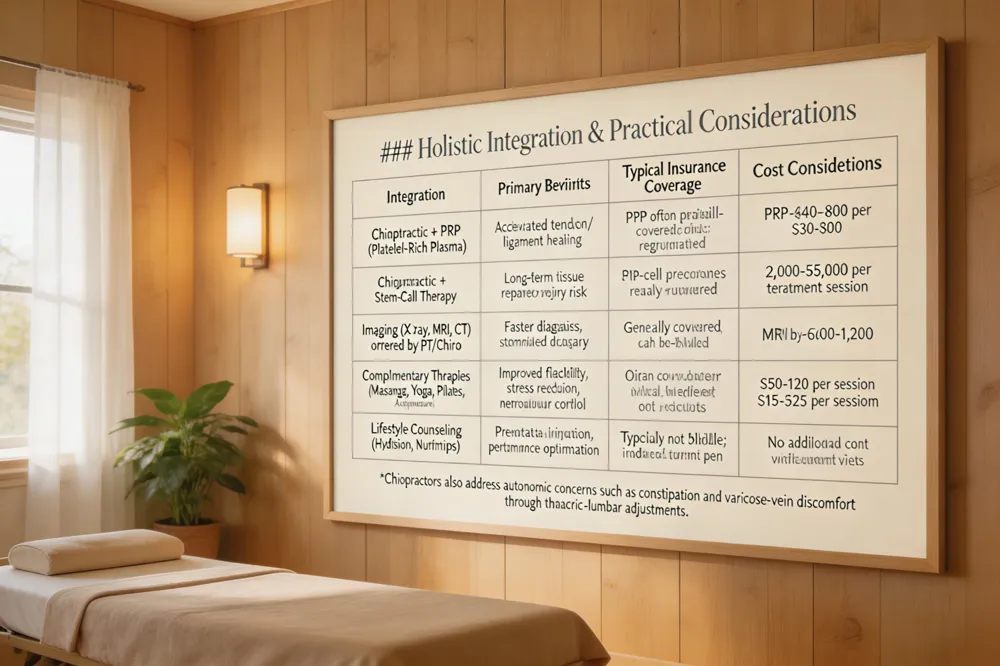
Holistic Integration & Practical Considerations
| Integration | Primary Benefits | Typical Insurance Coverage | Cost Considerations |
|---|---|---|---|
| Chiropractic + PRP (Platelet‑Rich Plasma) | Accelerated tendon/ligament healing, drug‑free regeneration | PRP often partially covered; chiropractic visits usually reimbursed | PRP $400‑$800 per injection; chiropractic $30‑$80 per visit |
| Chiropractic + Stem‑Cell Therapy | Long‑term tissue repair, reduced re‑injury risk | Stem‑cell procedures rarely covered; out‑of‑pocket | $2,000‑$5,000 per treatment session |
| Imaging (X‑ray, MRI, CT) ordered by PT/Chiro | Faster diagnosis, streamlined care pathway | Generally covered with medical‑necessity; can be billed to insurance | Varies by modality; MRI $600‑$1,200 |
| Complementary Therapies (Massage, Yoga, Pilates, Acupuncture) | Improved flexibility, stress reduction, neuromuscular control | Often covered under wellness benefits or out‑of‑pocket | $50‑$120 per session (massage); $15‑$25 per class (Yoga/Pilates) |
| Lifestyle Counseling (Hydration, Nutrition, Warm‑ups) | Preventative injury reduction, performance optimization | Typically not billable; included in treatment plan | No additional cost when integrated into visits |
Chiropractors also address autonomic concerns such as constipation and varicose‑vein discomfort through thoracic‑lumbar adjustments.
 Integrating Chiropractic care with regenerative medicine such as PRP and stem‑cell procedures creates a drug‑free, tissue‑healing pathway that many Colorado athletes prefer. A chiropractor can perform spinal and joint adjustments to improve nerve signaling, then coordinate PRP injections that deliver concentrated growth factors directly to damaged tendons or ligaments, accelerating recovery while preserving the athlete’s natural biomechanics.
Insurance coverage for Chiropractic care varies, but most plans reimburse spinal adjustments and soft‑tissue therapies. In Colorado, physical therapists are now authorized to order diagnostic imaging (X‑ray, MRI, CT) when clinically justified, streamlining care and reducing delays. Chiropractors often work with imaging specialists to confirm diagnoses before initiating treatment.
Alternative therapies that complement Chiropractic care include therapeutic massage, myofascial release, Yoga, Pilates, and acupuncture, all of which enhance circulation, flexibility, and neuromuscular control. Lifestyle counseling—adequate hydration, balanced nutrition, and sport‑specific warm‑ups—further supports injury prevention.
Beyond musculoskeletal issues, chiropractors can aid constipation by correcting thoracic‑lumbar subluxations that disrupt autonomic nerve flow, and they can alleviate varicose‑vein discomfort through adjustments that improve venous return and soft‑tissue work. These non‑musculoskeletal services expand the value of Chiropractic care for the whole athlete.
Putting It All Together: A Practical Roadmap for Athletes
Practical Roadmap for Athletic Care
| Sport | Acute Phase Visit Frequency | Sub‑Acute Phase Frequency | Typical Protocol Components | Monitoring Metrics |
|---|---|---|---|---|
| Tennis (elbow/shoulder) | 2‑3 visits/week (first 2‑3 weeks) | 1 visit/week (weeks 4‑6) then bi‑weekly maintenance | Spinal & joint adjustments, Graston®/ART, scapular stabilization, forearm eccentric loading | VAS pain score, shoulder ROM, grip strength, serve velocity |
| Football (knee/ankle) | 1‑2 visits/week (first 2‑3 weeks) | Bi‑weekly (weeks 4‑8) then weekly maintenance | Pelvic & lumbar adjustments, soft‑tissue release, proprioceptive balance drills, functional sport drills | Pain VAS, hop test distance, ankle stability index, sprint time |
| Running (shin splints/IT‑band) | 2 visits/week (first 2 weeks) | 1 visit/week (weeks 3‑6) then monthly | Lumbar adjustments, myofascial release, gait analysis, progressive stride work | VAS pain, stride length, cadence, weekly mileage |
| General Athlete (preventive) | Monthly check‑ins | Quarterly follow‑up | Full spinal/joint evaluation, biomechanical analysis, customized rehab program, adjunct modalities as needed | Functional movement screen (FMS), ROM, performance metrics specific to sport |
Progress is reassessed each visit with repeat ROM tests, pain scales, and sport‑specific performance data. Protocols are adjusted when goals are met or new deficits emerge.
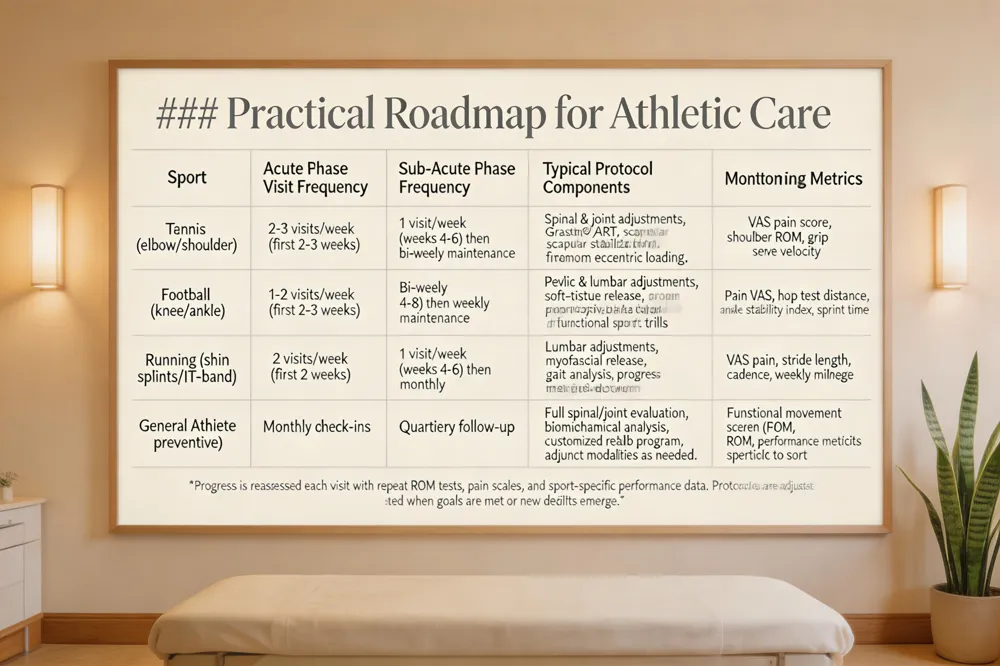 A systematic assessment of each athlete’s injury—whether a tennis elbow, rotator‑cuff strain, or a football knee sprain—starts with a full spinal and joint evaluation, biomechanical analysis, and functional testing. From this data the chiropractor creates a personalized protocol that may combine spinal adjustments, soft‑tissue techniques (e.g., ART, Graston), and sport‑specific rehabilitation drills.
Scheduling differs by sport. Tennis players benefit from 2‑3 visits per week during acute phases to restore shoulder and forearm mechanics, then taper to weekly maintenance. Football athletes, who often face high‑impact trauma, typically require 1‑2 visits per week for the first 2‑3 weeks, followed by bi‑weekly sessions that focus on lumbar, pelvic, and lower‑extremity alignment.
Progress is monitored through repeat range‑of‑motion tests, pain scales, and performance metrics; plans are adjusted when goals are met or new biomechanical deficits appear.
Running and chiropractic treatment – Adjustments and soft‑tissue therapy correct spinal misalignments, reduce inflammation, and improve nerve signaling, helping runners avoid shin splints, IT‑band syndrome, and knee pain while enhancing stride efficiency.
Acupuncture Glenwood Springs – Needle‑based therapy complements chiropractic care by lowering pain and inflammation, inducing a parasympathetic state; typical courses last 1‑4 sessions for acute issues and monthly for prevention.
Shockwave therapy side effects – Most patients experience mild, short‑term redness, swelling, or soreness that resolves within days; rare serious complications are minimized by qualified providers and proper dosing.
Optimizing Recovery and Performance Through Targeted Chiropractic Care
For tennis players, restoring thoracic and cervical mobility, addressing rotator‑cuff imbalances, and treating lateral epicondylitis with spinal adjustments, soft‑tissue therapy, and sport‑specific strengthening can shorten downtime and improve swing mechanics. Football athletes benefit from lumbar‑pelvic alignment, hip‑stability drills, and ankle‑joint mobilizations that enhance agility and reduce concussion‑related neck strain. Combining chiropractic care with regenerative options such as PRP or stem‑cell injections, and complementary modalities like shockwave, cryotherapy, or acupuncture, amplifies tissue healing while preserving a drug‑free approach. Colorado residents should contact a board‑certified Glenwood Springs chiropractor to receive a personalized assessment, evidence‑based treatment plan, and ongoing maintenance for lasting performance.