Introduction
Cold (low‑level) laser therapy delivers red and near‑infrared photons that penetrate 2‑5 cm of tissue without raising temperature, triggering photobiomodulation. Mitochondrial absorption of the light boosts ATP production, modulates reactive oxygen species and inflammatory cytokines, and stimulates fibroblast proliferation and collagen synthesis—key processes for accelerated skin wound healing and scar remodeling. Because the modality is non‑invasive, painless, and FDA‑cleared for pain, inflammation and tissue repair, chiropractic clinics can seamlessly incorporate it alongside adjustments, manual therapy, and therapeutic exercise. The combined approach offers a drug‑free, patient‑centered pathway that reduces edema, enhances microcirculation, and shortens recovery time for skin injuries, post‑surgical incisions, and musculoskeletal conditions that affect the integumentary system.
How Cold Laser Therapy Works at the Cellular Level
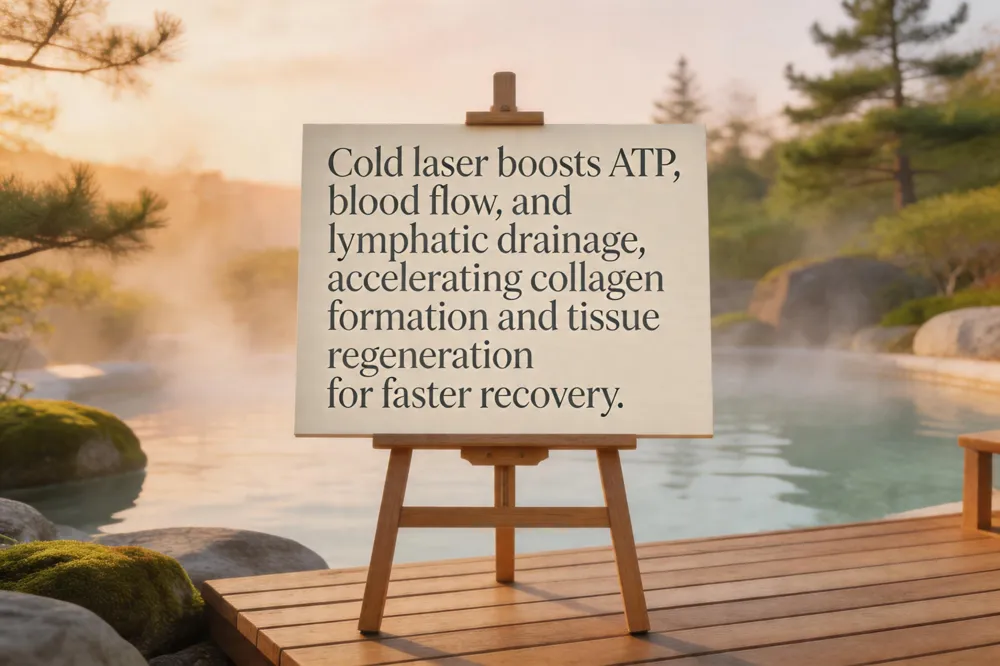 Does cold laser help healing? Yes. By increasing ATP, blood flow, and lymphatic drainage, cold laser enhances collagen formation and tissue regeneration, shortening recovery from sprains, tendonitis, and post‑surgical wounds. In chiropractic clinics the modality is often paired with adjustments to restore mobility faster.
Cold laser therapy side effects Minimal and transient—temporary skin redness, a mild tingling sensation, or brief aggravation of pain. Direct eye exposure is prohibited, and the therapy is contraindicated over malignant lesions, the thyroid, or during pregnancy.
Cold laser vs red light therapy Cold laser uses focused, higher‑power beams that penetrate 2‑5 cm, making it ideal for deep musculoskeletal injuries. Red‑light LED therapy reaches superficial layers and is best for skin rejuvenation and mild inflammation. Both rely on photobiomodulation, but cold laser provides deeper, faster tissue repair, whereas red light offers a gentle, low‑heat option for surface concerns.
Scientific Evidence Supporting Skin Repair
 Clinical trials have consistently demonstrated that low‑level laser therapy (LLLT) accelerates skin wound closure. In a triple‑blind, sham‑controlled study of partial‑thickness abrasions, laser‑treated wounds showed significantly smaller areas on days 6, 8, and 10 (P < .05) with large effect sizes (2.11, 1.46, 1.18), confirming faster wound contraction.
Wound‑contraction studies also reveal a systemic benefit: untreated wounds on the same limb contracted more than sham‑treated controls, suggesting photobiomodulation enhances overall tissue repair.
At the cellular level, LLLT up‑regulates fibroblast proliferation and collagen synthesis. Photons absorbed by cytochrome c oxidase increase ATP production, ROS signaling, and nitric‑oxide release, which together promote extracellular‑matrix remodeling and angiogenesis. Gene‑expression data show increased MAPK11, PDGF‑C, and serum‑response factor, while pro‑apoptotic genes are down‑regulated, leading to stronger, more organized scar tissue.
Dermatologic applications extend these mechanisms to acne, psoriasis, burns, vitiligo, and scar remodeling. FDA has cleared LLLT devices for pain relief, inflammation, and accelerated wound healing, and professional bodies such as APTA and ACA recognize it as an evidence‑based adjunct.
Low‑level laser therapy effectiveness – Systematic reviews report modest but statistically significant pain reductions (≈14‑19 mm VAS) and functional gains in chronic musculoskeletal conditions, with a favorable safety profile.
Low‑level laser therapy hair loss – Regular LLLT sessions increase terminal hair counts and thickness in androgenetic alopecia, offering a non‑invasive, drug‑free option.
Cold laser therapy Mayo Clinic – Mayo Clinic trials show reduced low‑back pain scores and accelerated recovery when LLLT is combined with physical therapy.
Low‑level laser therapy devices FDA approved – Devices such as the Erchonia FX 635 and other Class II/III systems are FDA‑cleared for pain, inflammation, and wound‑healing indications.
Low‑level laser therapy devices – Hand‑held wands and panel units delivering 650‑850 nm light are widely used in chiropractic clinics to complement adjustments and enhance tissue repair.
Best low‑level laser therapy devices – Reputable options include dual‑wavelength handheld units (e.g., SAMATULE Cold Red Light Therapy Wand) and higher‑power Class IV systems (e.g., Tendlite Pro) that provide deeper penetration and flexible dosing protocols.
Cold Laser Therapy in Chiropractic Care for Pain and Healing
 Cold laser therapy (low‑level laser therapy, LLLT) is a non‑thermal, non‑invasive modality that uses red and near‑infrared photons (600‑1000 nm) to boost mitochondrial ATP, reduce inflammatory cytokines, and stimulate fibroblast‑driven collagen synthesis. Because the light does not raise skin temperature (≤0.2 °F), it can be safely layered over chiropractic adjustments, enhancing post‑adjustment tissue recovery, decreasing edema, and accelerating healing of soft‑tissue injuries.
Adjunctive use with adjustments – Practitioners apply LLLT immediately after a spinal manipulation or manual therapy to modulate nociceptive signaling and improve microcirculation. The combined approach shortens the inflammatory phase of muscle strains, tendonitis, and post‑surgical incisions, leading to faster return of range of motion and functional mobility.
Treatment protocols – Typical regimens involve 2‑3 sessions per week, each lasting 5‑10 minutes per treated area, with energy densities of 2‑10 J/cm² (≈30‑200 mW output). Acute injuries often require 4‑8 visits; chronic conditions may need 12‑20 sessions over 4‑6 weeks. Patients usually feel a mild tingling during treatment and can resume normal activities immediately afterward.
Insurance and cost considerations – Many insurers (including Medicare when medically necessary) cover LLLT under CPT 97039 or HCPCS S8948, though coverage limits and co‑pays vary. Out‑of‑pocket fees range from $40‑$150 per session; a full course typically costs $300‑$1,800. Clinics frequently offer bundled discounts or financing options to improve affordability.
Key takeaways – Cold laser therapy is an evidence‑based, FDA‑cleared adjunct that complements chiropractic care, provides drug‑free pain relief, and promotes skin and soft‑tissue healing when delivered with standardized dosing protocols.
Choosing the Right Device and Understanding Drawbacks
 Cold‑laser (low‑level) therapy works by delivering non‑thermal photons that are absorbed by mitochondrial cytochrome c oxidase, boosting ATP production, fibroblast activity, and collagen synthesis. The FDA classifies most therapeutic devices as Class II medical devices and has cleared several systems—most notably Erchonia’s XLR8® and FX 635® lasers—for pain, inflammation, and accelerated wound healing. For a chiropractic practice a multi‑wavelength, Class IV system (e.g., 660 nm red + 808 nm near‑IR) with 500 mW‑1 W per diode offers deeper penetration, faster tissue repair, and the flexibility of pulsed and continuous modes. Hand‑held ergonomics and built‑in safety interlocks are essential to protect both patient and clinician.
Two practical drawbacks should be considered. First, meaningful clinical improvement usually requires multiple sessions (2‑4 per week for several weeks), which can increase treatment time and cost. Second, patient response is variable; some experience rapid pain relief while others see minimal benefit, making outcome prediction difficult and often requiring protocol adjustments. Side effects are rare and mild—temporary redness, a tingling sensation, or brief aggravation of pain—but direct eye exposure must be avoided and therapy is contraindicated over malignant lesions, the thyroid, or in pregnancy. When applied by a qualified practitioner, cold‑laser therapy remains a safe, drug‑free adjunct to chiropractic care.
Special Populations and Patient Concerns
 Age considerations: Low‑level laser (cold) therapy is safe for seniors; studies in adults 65+ show reduced inflammation, improved joint mobility, and faster wound closure when treatments are 2‑3 times/week for 10‑20 minutes. It also stimulates collagen, helping skin texture in older patients. ContraIndn: The therapy is non‑thermal and has minimal side effects, but eye protection is mandatory. Contraindicated over malignant tumors, thyroid tissue, or in pregnancy until more safety data are available. Direct laser exposure to the eyes must be avoided. Patient reviews: Positive feedback highlights pain relief, faster tissue repair, and improved range of motion, especially after sports injuries or back pain. Some complaints involve high cost or perceived lack of benefit, underscoring the need for qualified providers and clear dosing protocols. Answers to key questions: • Does red light therapy work on a 70‑year‑old woman? Yes—its cellular‑level effects reduce age‑related joint stiffness and aid wound healing when no photosensitivity or contraindications exist. • QC Kinetix reviews and complaints: Over 4,000 five‑star testimonials contrast with a BBB rating of 2.32/5 and reports of cost concerns and limited improvement, indicating mixed consumer experiences. • Cold laser therapy side effects: Generally mild—temporary redness, tingling, or brief pain flare‑up; serious adverse events are rare. • Is cold laser therapy a hoax? No—FDA‑cleared devices have documented physiological effects, though low‑quality consumer units may overpromise. Proper clinical use is evidence‑based and safe.
Shockwave Therapy: A Complementary Non‑Invasive Modality
 Shockwave therapy, also called extracorporeal shockwave therapy (ESWT), delivers focused acoustic energy into muscles, tendons, and joints. The mechanical stimulus promotes micro‑circulation, de‑brains calcific deposits, and triggers cellular pathways that accelerate tissue repair without heat or incision. Clinically it is used for chronic back, neck and shoulder pain, plantar fasciitis, tendinitis, acute‑, and post‑surgical scar tissue, often integrated with chiropractic adjustments and therapeutic exercise to restore mobility.
Cost varies from $150‑$300 per session; a typical course of 3‑5 sessions may total $500‑$1,500. Most insurers label ESWT experimental, so coverage is limited, although some plans reimburse when deemed medically necessary for orthopedic conditions. Flexible payment options and health‑care credit are often available.
Safety profile is strong: the most common side effects are transient redness, mild swelling, or brief soreness that resolves within days. Rare complications—such as skin burns or nerve irritation—occur only with improper dosing or use on contraindicated patients (e.g., active infection, pregnancy near the treatment site).
Shockwave therapy near me – Glenwood Chiropractic in Glenwood Springs, CO offers FDA‑cleared SoftWave ESWT for back, knee, shoulder, and other musculoskeletal complaints.
Shockwave therapy machine – The clinic’s radial‑focused device delivers precise acoustic waves that target both superficial and deep tissues, reducing pain and inflammation.
How much does shockwave therapy cost – Sessions cost $150‑$300; a full treatment plan typically ranges $500‑$1,500.
Shockwave therapy side effects – Mild, temporary increase in pain, redness, bruising, or swelling; serious events are rare.
Is shockwave therapy covered by insurance – Coverage depends on the plan; many insurers require documentation of medical necessity for orthopedic indications.
Can shockwave therapy cause damage – When performed by a qualified provider with an FDA‑cleared device, serious injury is uncommon; contraindications must be screened.
Shock Therapy – ESWT is a non‑invasive, drug‑free option that, with chiropractic care, speeds healing and improves functional outcomes.
Conclusion
Key Takeaways: Low‑level laser (cold laser) therapy is a non‑thermal, non‑invasive modality that stimulates mitochondrial ATP production, modulates reactive oxygen species, and up‑regulates fibroblast activity. These cellular actions reduce inflammation, edema, and pain while accelerating collagen synthesis and angiogenesis, leading to faster skin wound closure and improved musculoskeletal recovery. FDA clearance and endorsement by the APTA, ACA, and AAOS confirm its safety and evidence‑based role as an adjunct to chiropractic care.
Patient Guidance: Ideal candidates include individuals with acute or chronic musculoskeletal pain, post‑adjustment soreness, and superficial to deep skin wounds such as abrasions, burns, or surgical incisions. Sessions are brief (1‑5 minutes per area), painless, and typically repeated 2‑4 times weekly for several weeks. Contraindications are limited to active malignancy, pregnancy, and direct ocular exposure; protective eyewear is mandatory.
Future Outlook: Ongoing research is refining optimal dose parameters and expanding applications to chronic ulcers and regenerative medicine. As dosing for and integration with other regenerative therapies grow, cold laser therapy will likely become a cornerstone of holistic, drug‑free rehabilitation programs.